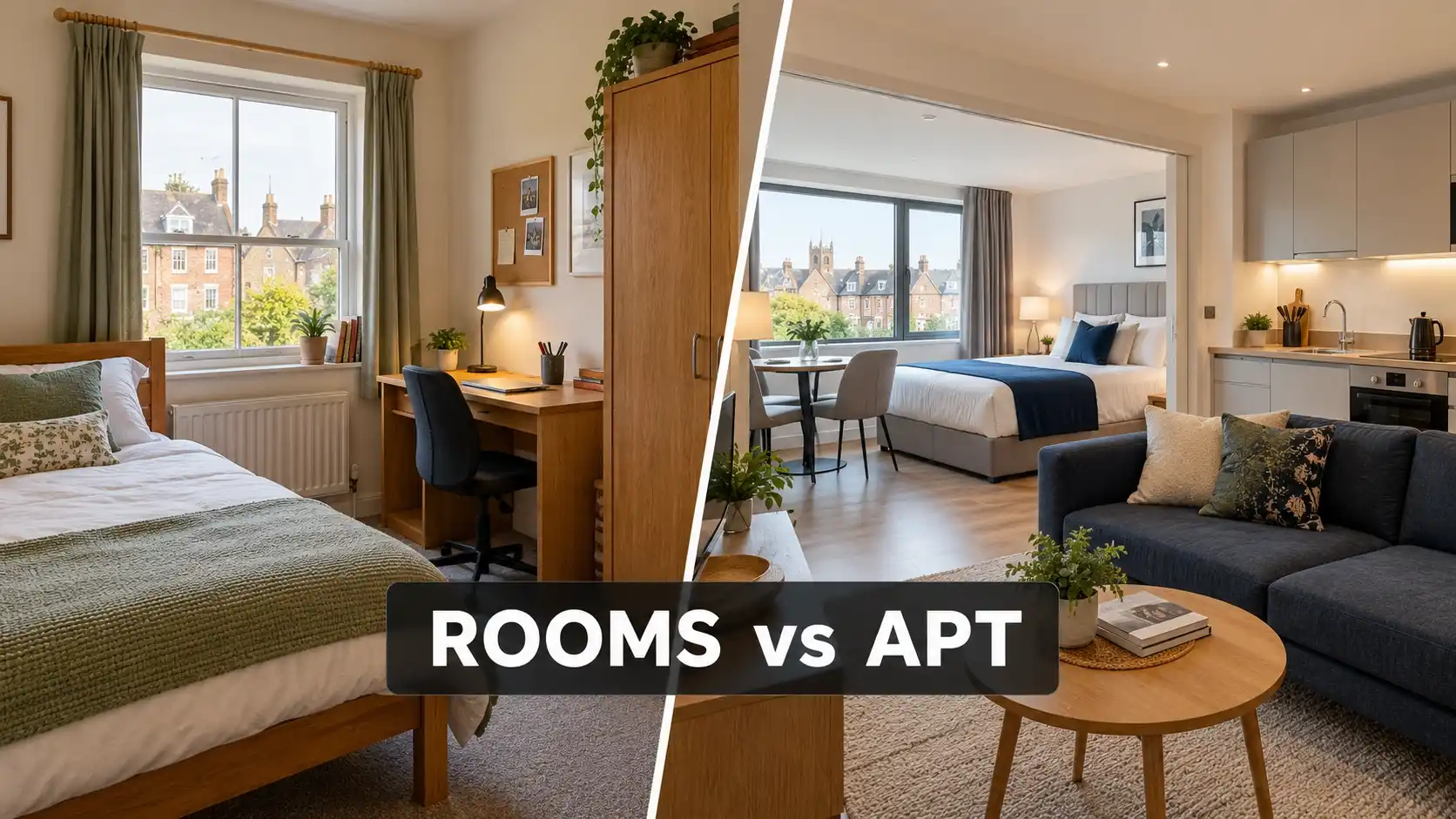

Budget £25–£35 per person per night in regional UK towns, £30–£45 in major cities and £45–£70 in London. Those are all-in contractor rates for a bed in a shared house or apartment with a kitchen, bills and parking, not hotel rates, which start around £70 and climb fast once breakfast and parking land on the invoice.
The number that actually decides your budget isn’t the region, though. It’s how long the booking runs and how many extras sit outside the quoted rate.
Here’s the full picture: real 2026 rates, the costs that get missed, the long-stay levers worth pulling, and a worked crew budget you can lift straight into a tender.
What should you budget for contractor accommodation in the UK?
Work on £25–£35 per person per night outside the big cities. That figure should include the bed, bills, Wi-Fi, weekly cleaning and, anywhere outside a city centre, parking.
| Location type | Per person per night | Notes |
|---|---|---|
| Regional towns and rural sites | £25–£35 | Cheapest tier, but thinnest supply |
| Major cities (Manchester, Leeds, Birmingham, Liverpool, Sheffield, Bristol) | £30–£45 | Good availability, competitive market |
| Aberdeen | £40–£60 | Offshore demand keeps rates high |
| London | £45–£70 | Studio in zones 3–4 up to a well-fitted zone 2 house share |
| Regional hotel (comparison) | £70–£100 | Single occupancy, no kitchen |
For context, the UK national average hotel rate was £124.48 a night in January 2026, with London at £177.91. Even budget chains sit at £40–£80 before breakfast. On a crew booking that difference compounds into five figures fast.
What actually drives the per-night rate?

Four things, roughly in this order of impact: how long you’re booking, where the site is, how many beds you need, and what’s bundled into the rate.
Length of stay does most of the work
Providers discount duration harder than volume. A guaranteed six-month booking typically earns a better rate than 20 beds for one week, because the void risk disappears. Expect 20–30% off list on a properly committed long booking.
The practical read: if the programme says twelve weeks, book twelve weeks. Rolling weekly extensions cost more and give you no negotiating position.
Location, but not the way you’d think
Rural and market-town rates look cheap on paper. The catch is supply, near a major project there may only be a handful of suitable properties, and they get taken early. A £28 rate you can’t book is worth less than a £34 rate you can.
Crew size
Whole-property bookings for four to ten people almost always beat per-room pricing. You’re buying space rather than keys, and one three-bed house for six people removes six sets of breakfast, parking and evening meal costs at the same time.
What’s included
This is where two quotes at the same headline rate stop being comparable, covered properly below.
What’s the real all-in cost per person, per night?
Once you count food, parking and laundry, a hotel runs roughly £80 a night more per person than contractor accommodation with a kitchen. Here’s a like-for-like comparison for one worker in a regional UK location.
| Cost line | Budget hotel | Contractor house | Serviced apartment |
|---|---|---|---|
| Bed | £70 | £30 | £45 |
| Breakfast | £12 | £3 | £3 |
| Parking | £10 | £0 | £0 |
| Evening meal | £25 | £7 | £7 |
| Laundry | £5 | £0 | £0 |
| All-in per night | £122 | £40 | £55 |
All-in cost per person per night (regional UK)

Contractor house       █████░░░░░░░░░░░░░░░   £40
Serviced apartment     ███████░░░░░░░░░░░░░   £55
Budget hotel + extras  █████████████████░░░   £122
3-star hotel + extras  ████████████████████   £147
A kitchen is the single biggest line item in that table. It’s worth roughly £30 a day per person in avoided food spend, and it’s the reason contractor accommodation wins on cost even when the bed rate is similar.
How do long stays cut the budget further?

Two levers, and most site managers only use one. The first is the discount ladder. The second is the 28-day VAT rule, which is worth about 16 percentage points on the accommodation element and is routinely missed.
The discount ladder
Most operators step rates down at recognised thresholds. Typical shape:
| Nights booked | Typical discount |
|---|---|
| 7+ | 5–10% |
| 14–20 | 10–15% |
| 30+ | 15–25% |
| 90+ | 20–30% |
The 28-day VAT rule
If the same person stays in the same accommodation for more than 28 continuous nights, a reduced value rule applies from night 29. At least 20% of the charge stays standard-rated as facilities, which brings the effective VAT on the accommodation element down to roughly 4% instead of 20%.
Three conditions catch people out:
- It must be a continuous stay. A run of weekly bookings does not qualify.
- It must be the same individual. Rotating three people through one bed over 90 days doesn’t trigger it.
- The relief applies from night 29 onward, not retrospectively to the first 28.
Ask any provider directly whether they apply the reduced value rule, and get the answer in writing. Confirm the treatment with your accountant before it goes in a budget.
What isn’t in the quoted rate?
The extras below are where a £28 quote quietly becomes a £36 quote. Ask about every line before you compare two providers.
| Extra | Typical cost | Watch for |
|---|---|---|
| Bills and Wi-Fi | £0–£8 per night | Should be included; if not, ask why |
| Weekly cleaning | ~£30 per visit | Sometimes billed separately |
| Linen change | £15–£35 per turnover | Often excluded on whole-house lets |
| Parking | £0–£15 per night | A red flag outside city centres |
| Damage deposit | £200–£500 per property | Check the return terms |
| Early termination | 7–28 days’ notice | The costliest clause when a package finishes early |
| Late cancellation | Varies widely | Matters most when start dates slip |
The single best procurement habit here is asking for one fully inclusive figure covering bills, Wi-Fi, weekly cleaning and parking. Otherwise you’ll pick the £28 rate over the £32 rate and pay more.
What does a crew of eight actually cost?
Take a realistic package: eight operatives, twelve weeks, regional site. That’s 672 person-nights.
| Option | Rate per person per night | Total |
|---|---|---|
| Budget hotel plus breakfast | £82 | £55,104 |
| Contractor houses at list | £30 | £20,160 |
| Contractor houses, 25% long-stay rate | £22.50 | £15,120 |
| Same, with the 28-day VAT relief applied | ~£20.50 blended | £13,776 |
The gap between the first row and the last is over £41,000 on a single package. It’s the same eight people doing the same work, the difference is entirely in how the accommodation was structured.
The commute-versus-stay break-even
Worth running before you book anything. HMRC’s approved mileage rate is 45p a mile for the first 10,000 miles and 25p thereafter, unchanged for 2026/27.
At £30 a night for a bed, the break-even is a round trip of about 67 miles, roughly 33 miles each way. Beyond that, putting someone up overnight costs less than paying their mileage, before you count the fatigue risk or the productive hours lost to a two-hour commute.
For crews travelling from further afield, it stops being a close call quickly.
Why availability is tighter than the price suggests
Rates look reasonable in 2026. Availability doesn’t, and that’s the risk to plan around. UK construction is in an unusually heavy build cycle, and the projects driving it are concentrated in exactly the kinds of towns where accommodation supply is thin.
- Hinkley Point C is at peak construction, with around 26,000 people on the project across Britain and roughly 12,000 on site. The two campuses hold about 1,500 beds between them, the private market absorbs the rest.
- Sizewell C is building a 2,400-bed campus at Leiston, which tells you what the project expects local supply to be unable to cover.
- Battery gigafactories, data centres and HS2 are pulling crews into a handful of regions simultaneously.
- CITB’s workforce outlook puts the industry’s requirement at around one million additional workers by 2030, backed by £600m of government training investment.
The practical consequence is simple: near any large project, book earlier than feels necessary. Somerset towns like Bridgwater and Highbridge tighten noticeably whenever a fit-out package mobilises, and Milton Keynes does the same around rail and logistics builds.
What to specify when you request a quote
Providers can only price accurately from real detail. Send these and you’ll get a firm number rather than a range:
- Site postcode: not just the town
- Exact dates: including whether the end date is firm or programme-dependent
- Headcount and split: how many rooms, whether sharing is acceptable
- Shift pattern: nights, early starts, weekend working
- Vehicles: how many spaces you need
- Invoicing: company name, PO reference, payment terms
- Special requirements: drying space, secure tool storage, ground-floor access
Then ask three questions back: is the rate fully inclusive, what’s the notice period, and do you apply the 28-day VAT rule?
That’s the level of detail we work from at Guests House. We run serviced apartments and whole houses across Somerset – Bridgwater, Highbridge, Taunton and Yeovil, plus Milton Keynes, with parking, full kitchens, self check-in for late arrivals and company invoicing on extended stays. Send us a postcode, dates and headcount and we’ll tell you honestly whether we can cover it.
FAQs
How much is contractor accommodation per night in the UK?
£25–£35 per person per night in regional towns, £30–£45 in major cities, and £45–£70 in London. Aberdeen runs £40–£60 because of offshore demand.
Is contractor accommodation cheaper than a hotel?
Substantially, on stays over a few nights. All-in, a contractor house runs about £40 per person per night against roughly £122 for a budget hotel once breakfast, parking and meals are counted.
What discount should I expect on a long booking?
20–30% off list on a committed 90-night booking. Providers discount duration more readily than headcount.
Does VAT drop on long contractor stays?
Yes. From night 29 of a continuous stay by the same person, the reduced value rule cuts effective VAT on the accommodation element to roughly 4%.
What’s usually excluded from a contractor accommodation quote?
Linen changes, weekly cleaning, parking in city centres, damage deposits and maintenance call-outs. Always ask for one fully inclusive figure.
How far in advance should I book crew accommodation?
Near a major project, as soon as the package is confirmed. Supply in market towns is thin and gets taken weeks ahead of mobilisation.
Do providers invoice the company directly?
Most contractor-focused operators do, typically monthly with a PO reference. Confirm payment terms before booking rather than at check-in.
When is it cheaper to commute than to stay over?
Under about 33 miles each way. Beyond that, the 45p HMRC mileage rate costs more than a £30 bed, before fatigue and lost hours.