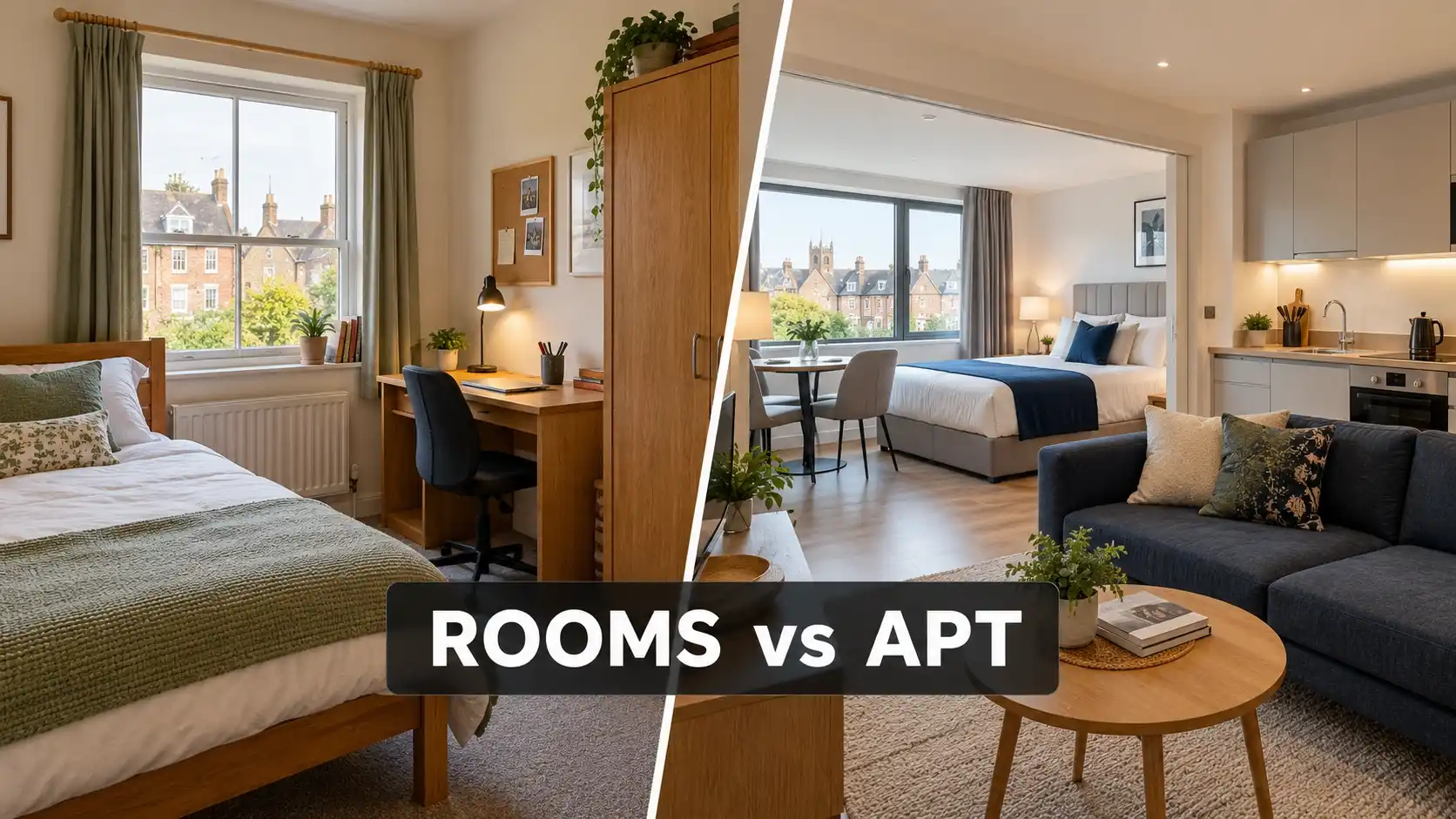

For one or two nights, a hotel usually wins. From around night four or five, a serviced apartment normally costs less, and past 28 nights it isn’t close, because a VAT rule cuts the accommodation charge dramatically.
The gap isn’t really about the headline rate. It’s about breakfast, parking, evening meals and laundry, which quietly add £40–£55 a night to a hotel stay and almost nothing to an apartment with a kitchen.
Below is the full per-night breakdown: what each option genuinely costs, where the break-even point sits, how the VAT rule works, and when a hotel is still the smarter booking.
Which is Cheaper: a Serviced Apartment or a Hotel?
On the headline rate they’re often similar. On the all-in cost per night, serviced apartments typically run about 25% cheaper than comparable hotel rooms, and the gap widens with every extra night. The industry rule of thumb is that they also give you roughly 30% more space.
Here’s the short version before the detail:
| Length of stay | Usually cheaper | Why |
|---|---|---|
| 1–3 nights | Hotel | No minimum stay, city-centre locations, no grocery run |
| 4–7 nights | Roughly level | Apartment pulls ahead once meals and parking compound |
| 8–28 nights | Serviced apartment | Long-stay discounts kick in; laundry and food costs collapse |
| 29+ nights | Serviced apartment, clearly | Reduced-value VAT rule applies from night 29 |
What Does a Hotel Night Actually Cost?
The UK national average hotel rate was £124.48 per night in January 2026, with London averaging £177.91. A regional three-star typically sits at £80–£120. But almost nobody pays only the room rate.
Add the standard extras a business traveller can’t avoid:
| Extra | Typical cost per night |
|---|---|
| Breakfast | £8–£12 continental, £12–£18 full English |
| Parking | £10–£25 (up to £40 in central London) |
| Wi-Fi (some hotels) | £5–£10 |
| Evening meal out or room service | £20–£30 |
| Laundry / dry cleaning | £5–£15 per item |
A room advertised at £100 realistically lands at £130–£150 before dinner. Add an evening meal and you’re at £150–£175 for one person, one night.
The extras nobody budgets for
Three costs regularly blow a travel budget and none of them appear on the booking confirmation:
- Eating out every night. Two weeks of restaurant dinners at £25 is £350. The same fortnight cooked in an apartment kitchen runs closer to £100.
- Hotel laundry. £5–£15 per item adds up fast on a three-week assignment.
- Time. Waiting for breakfast service and finding somewhere to eat at 9pm after a late finish has a real cost, even if finance never sees it.
What Does a Serviced Apartment Night Cost?
Expect roughly £85–£130 a night for a one-bedroom in a regional UK town or city, and £150–£250 in London. That figure normally includes bills, Wi-Fi, a full kitchen, weekly housekeeping and, outside city centres, parking.
The important difference is what stops being an extra:
- Breakfast, because there’s a kitchen
- Parking, at most non-central properties
- Wi-Fi, always included
- Laundry, because there’s a washing machine
- Evening meals, if the traveller chooses to cook
Long-stay pricing is the other lever. Most operators discount by length of stay rather than by room count, so a month-long booking is materially cheaper per night than four separate weekly ones. At Guests House our rates step down the longer the booking runs, across apartments in Milton Keynes and across Somerset, and bills are included in the rate rather than added afterwards.
What a serviced apartment costs you that a hotel doesn’t
Worth being straight about the trade-offs, because they’re real:
- Minimum stays. Many operators won’t take a one-night booking at all, which rules apartments out for quick trips.
- Weekly housekeeping, not daily. Fine for most people, a genuine downgrade for some.
- No 24-hour reception. Self check-in is quicker when it works, but there’s no front desk at 2am.
- Location. The best-value apartments often sit slightly outside the centre, which can mean a short drive or a longer walk to the office.
- A grocery shop. The food savings only exist if the traveller actually cooks.
The Per-night Cost Breakdown, Side by Side
Here’s a worked example for one business traveller in a regional UK town, using mid-range figures for both options.
| Cost line | Hotel (3-star) | Serviced apartment (1-bed) |
|---|---|---|
| Room / apartment rate | £95 | £95 |
| Breakfast | £14 | £3 (self-catered) |
| Parking | £12 | £0 |
| Evening meal | £25 | £7 (cooked) |
| Laundry | £5 | £0 |
| True cost per night | £151 | £105 |
That’s a £46 daily gap before any long-stay discount. Scaled up:
Total cost by length of stay (one traveller, regional UK)

 5 nights   Hotel  ███████░░░░░░░░░░░░░   £755
            Apt    █████░░░░░░░░░░░░░░░   £525

30 nights   Hotel  ████████████████████   £4,530
            Apt    ███████████░░░░░░░░░   £2,580

90 nights   Hotel  ████████████████████   £12,354
            Apt    ███████████░░░░░░░░░   £7,112
The 30 and 90-night apartment figures assume a long-stay discount taking the rate to about £76, and the 90-night figures apply the VAT rule below to both options. Your numbers will differ, but the shape of the curve won’t.
Where the break-even sits
Around night four to five for most regional bookings. Before that, the hotel’s flexibility and central location usually justify the premium. After it, every additional night widens the gap by roughly £40–£50.
For a 90-night project posting, that difference is over £5,000 for a single traveller. Put four people on the same job and you’re comparing £28,000 against £49,000.
Teams change the answer faster than length of stay
Four colleagues on the same assignment need four hotel rooms. In apartment terms, they might need one three-bedroom property, or two two-beds, and the per-head rate drops sharply because you’re paying for space rather than keys.
It also removes four separate breakfast bills, four parking charges and four restaurant dinners a night. On a crew booking the gap between the two options often opens up by night two or three rather than night four or five.
Around 23% of UK corporates now hold agreements with serviced accommodation providers, and team bookings are usually what pushes a travel programme in that direction.
How The 28-day VAT Rule Changes the Maths
If the same person stays in the same accommodation for more than 28 continuous nights, the reduced value rule applies from night 29. At least 20% of the accommodation charge stays standard-rated as “facilities” so the effective VAT on the accommodation element drops to roughly 4% instead of 20%.
Two things travel managers get wrong here:
- It applies to hotels too. This isn’t a serviced apartment loophole. A hotel guest on a genuinely continuous 29-plus night stay qualifies as well.
- A run of short bookings doesn’t count. HMRC is explicit that accommodation supplied to a succession of different people for periods under 29 days doesn’t qualify. Rolling weekly reservations, or rotating three people through one room, will not trigger the relief.
That’s why the structure of the booking matters as much as the rate. One continuous 90-night reservation for one named person beats thirteen weekly bookings at the same nightly price, sometimes by thousands. Ask any provider directly: do you apply the reduced value rule from night 29? Confirm the treatment with your accountant before you build it into a budget.
What HMRC Subsistence Rates do and Don’t Cover
The benchmark scale rates cover meals and incidentals only, never accommodation. That catches people out when they try to build one per-night figure for finance.
| Journey length | Benchmark rate |
|---|---|
| 5 hours or more | £5 |
| 10 hours or more | £10 |
| 15 hours or more, ongoing past 8pm | £25 |
| Supplement when a 5 or 10-hour journey runs past 8pm | £10 |
The practical read-across: an apartment kitchen doesn’t just reduce spend, it usually brings a traveller comfortably inside the meal allowance instead of pushing them over it with a £28 restaurant bill.
When a Hotel is Still the Right Call
Plenty of the time, honestly. A serviced apartment isn’t automatically the answer.
Book the hotel when:
- The trip is one to three nights, minimum stays and a grocery run make no sense
- You need a city-centre address at short notice
- Someone needs daily housekeeping rather than weekly
- The traveller genuinely won’t cook, so the food saving never materialises
- Loyalty scheme points matter to the individual or the programme
Book the apartment when the stay runs past a week, when more than one person is travelling together, when the assignment has a moving end date, or when the traveller needs a proper desk and somewhere to eat at 10pm.
Choosing Between Them for Your Next Assignment
Work it out in this order and the answer usually presents itself:
- Count the nights: Under four, book the hotel. Over seven, price the apartment.
- Price the extras, not the rate: Breakfast, parking, Wi-Fi and dinner, per night, both ways.
- Check the booking structure: One continuous reservation, one named guest, if the stay will pass 28 nights.
- Ask what’s genuinely included: bills, housekeeping frequency, parking, linen changes.
- Confirm the invoicing: Company billing, PO references and payment terms before you commit.
If you’d like the comparison run against real numbers, our business and extended stay apartments cover Bridgwater, Taunton, Yeovil and Highbridge in Somerset, plus Milton Keynes. Bills are included, cancellation is free up to 24 hours before arrival, and we’ll tell you honestly if a hotel is the better call for a two-night trip. Get in touch with your dates and headcount and we’ll price it properly.
FAQs
Are serviced apartments cheaper than hotels?
On all-in cost, usually yes, around 25% less than a comparable hotel room, and more once meals, parking and laundry are counted. For one to three nights, hotels often win.
How many nights before a serviced apartment is worth it?
Typically four to five nights in regional UK locations. Past a week the gap becomes significant.
Do serviced apartments have a minimum stay?
Many do, commonly two to seven nights, though it varies by operator and season. Always check before comparing rates.
What’s included in a serviced apartment rate?
Normally bills, Wi-Fi, a fully equipped kitchen and weekly housekeeping. Parking is usually included outside city centres.
Is VAT cheaper on long stays?
From night 29 of a continuous stay by the same person, the reduced value rule brings the effective VAT on the accommodation element down to roughly 4%.
Do HMRC subsistence rates cover accommodation?
No. The £5, £10 and £25 benchmark rates cover meals and incidentals only. Accommodation is budgeted separately.
Can a company be invoiced directly for a serviced apartment?
Most corporate-facing operators invoice companies directly, often monthly, with PO references. Confirm terms before booking.
Are serviced apartments good for relocations?
Yes, they’re commonly used as bridging accommodation while an employee finds permanent housing, because they need no furniture, no utility set-up and no long tenancy.