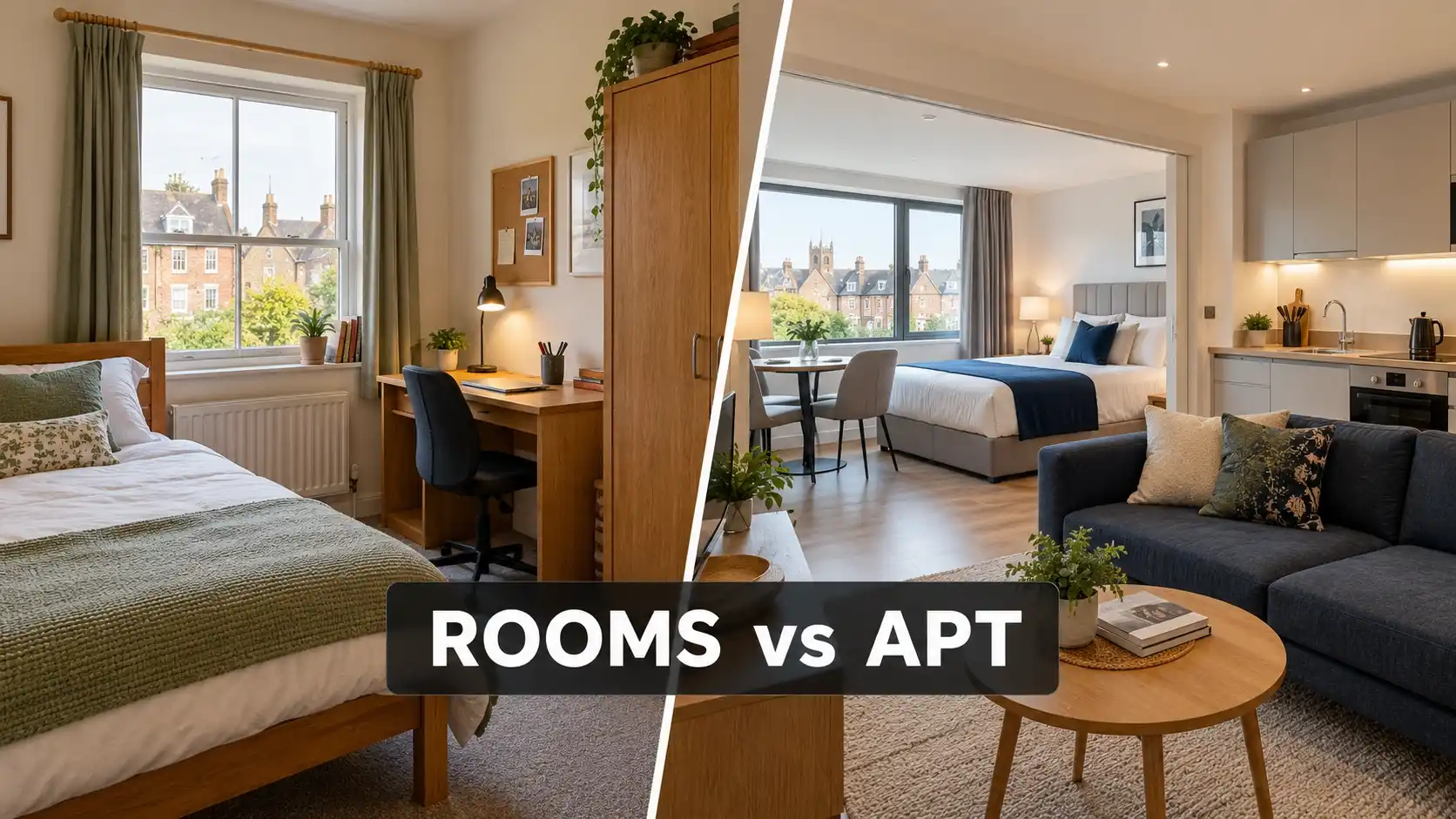
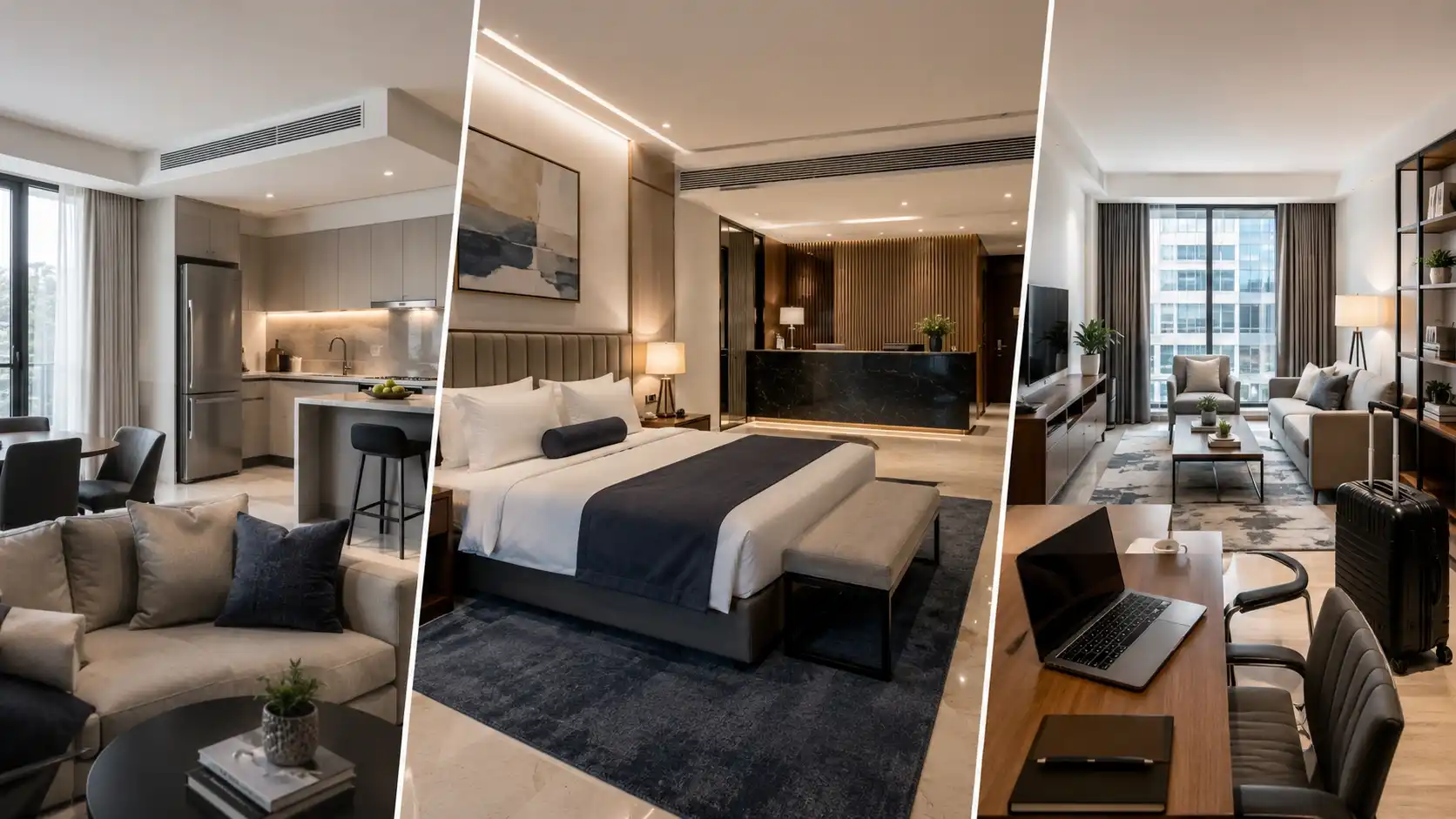
A serviced apartment is a fully furnished, self-contained flat or house let short-term, with bills, Wi-Fi and housekeeping included in one rate. Think of it as a private apartment with hotel-style servicing, a kitchen, a living area and your own front door, but no tenancy, no utility set-up and no furniture to buy.
For HR and travel managers, the fittings aren’t the useful part. The contract, the billing and the duty-of-care position all work differently from a hotel.
This guide covers what a serviced apartment is, how it differs from an aparthotel or a company let, what to check before approving a provider, and how to write it into a travel policy.
What is a serviced apartment?
A self-contained furnished home let with services included, on stays from a few nights to several months. The defining features are a private kitchen, a separate living space and an all-inclusive rate, as opposed to a hotel room, where you’re buying a bedroom and paying separately for everything else.
What a standard UK serviced apartment rate normally includes:
| Included as standard | Usually extra |
|---|---|
| Furniture and full kitchen equipment | Additional mid-week housekeeping |
| Gas, electricity and water | Parking in some city centres |
| Wi-Fi and smart TV | Pet fees |
| Weekly housekeeping and linen change | Early check-in / late check-out |
| Towels and starter consumables | Damage above normal wear |
| Council tax or business rates | Additional keys or fobs |
This is a real sector, not a niche. An independent review by ASAP and BONARD counted more than 56,700 serviced apartments across the UK, worth around £1.7 billion, with roughly half of those units operating under a recognised brand. England accounts for 87% of the stock.
Who’s actually staying in them tells you what they’re for: 45% business travellers, 23% relocating professionals and 27% tourists.
Serviced apartment, aparthotel or corporate housing – what’s the difference?
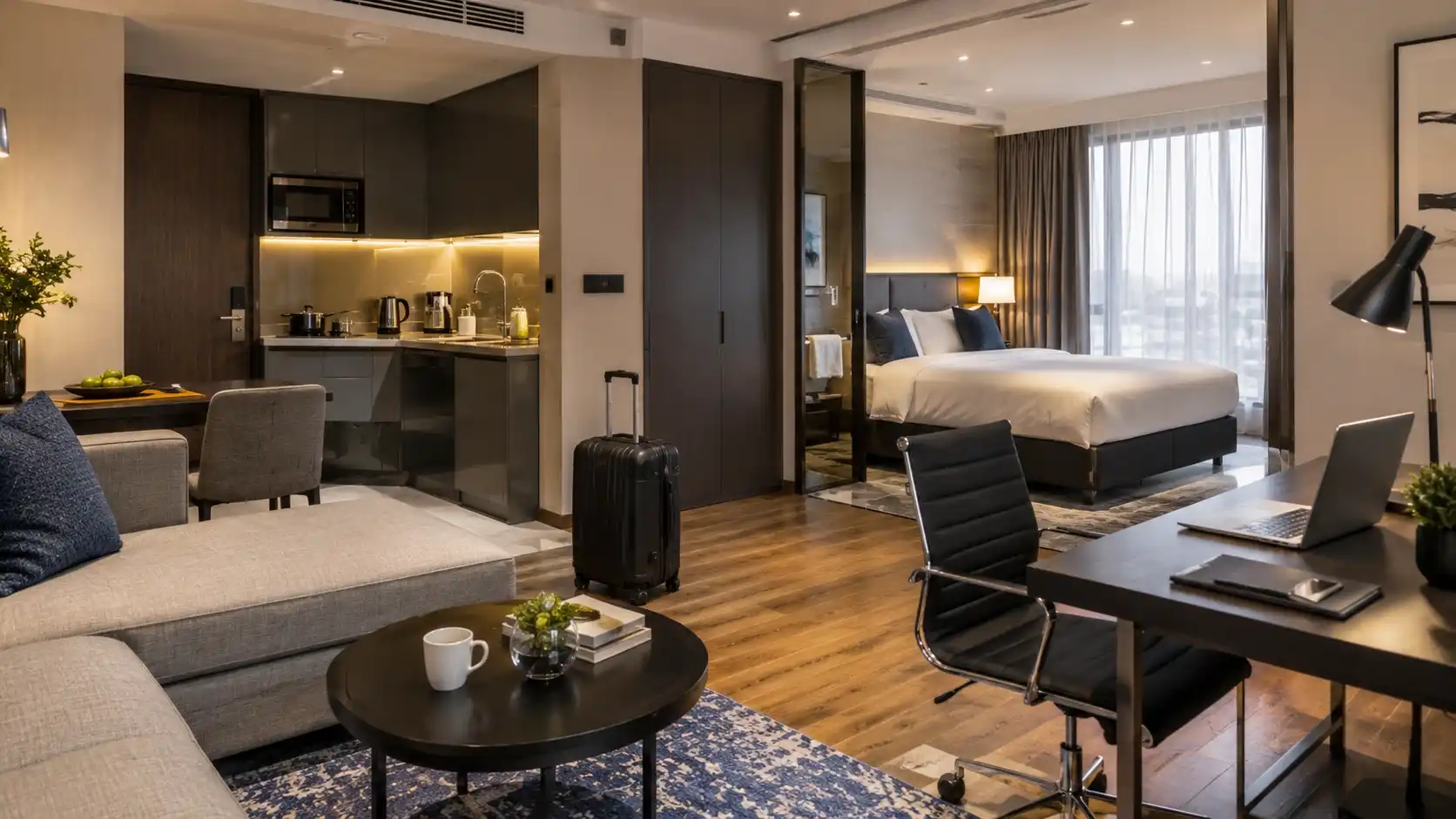
They overlap, and the terms get used loosely. The practical difference is service level and typical stay length.
| Type | Typical stay | Reception | Housekeeping | Best for |
|---|---|---|---|---|
| Serviced apartment | 2 nights – 12 months | Usually none; self check-in | Weekly | Project work, relocations, contractors |
| Aparthotel | 1 night – 3 months | Staffed, hotel-style | Daily or weekly | City-centre business travel |
| Extended stay hotel | 3 nights – 3 months | Staffed | Daily | Travellers wanting hotel service plus a kitchenette |
| Corporate housing | 30 days – 12 months+ | None | Fortnightly or on request | Long assignments, family relocations |
| Company let | 6 – 24 months | None | None | Permanent-ish placements, cost-led moves |
Typical stay length, at a glance:
Hotel              █░░░░░░░░░░░░░░░░░░░   1–5 nights
Aparthotel         ████░░░░░░░░░░░░░░░░   1 night – 3 months
Serviced apartment █████████████░░░░░░░   2 nights – 12 months
Corporate housing  ████████████████░░░░   1 – 12+ months
Company let        ████████████████████   6 – 24 months
An aparthotel is essentially a building full of serviced apartments with a front desk. In planning terms most UK serviced apartment stock sits in C1 use class (71%), the same class as hotels, with a further 26% in C3 residential — a detail that matters if you’re ever asked whether a property is being used lawfully.
A company let is the outlier. It’s a tenancy granted to a business rather than a person, usually unfurnished or part-furnished, with the employer taking on landlord-tenant obligations for the term. It’s cheaper per month and far less flexible.
Is a serviced apartment a tenancy?
No, and this is the point most HR teams miss. A serviced apartment stay is normally a licence to occupy, not a tenancy. The operator retains control of the property and provides services; your employee has permission to stay, not exclusive possession.
Three consequences worth knowing:
- No assured shorthold tenancy: No deposit protection scheme, no Section 21 process, no six-month minimum.
- The operator can enter: for housekeeping and maintenance, as set out in the booking terms.
- Ending the stay is a notice period, not an eviction: typically 7 to 30 days depending on the contract.
By contrast, if you sign a company let, you’re in tenancy territory. Company lets sit outside the standard AST regime because the tenant is a business rather than an individual occupying it as their only or main home, which means different rights, different exit routes and a legal review before signature.
If flexibility matters more than the lowest monthly figure, the licence model is usually what you want.
When should HR book a serviced apartment instead of a hotel?
Whenever the stay runs past about four or five nights, whenever more than one person is travelling together, or whenever the end date isn’t fixed. Below that, a hotel is usually simpler and often cheaper.
The common use cases:
- Project and contractor deployments. Crews of four to ten in one property, with a kitchen and parking.
- Relocations. Bridging accommodation while an employee finds permanent housing — no furniture, no utility accounts, no long tenancy.
- Interim and consultant placements. Three to six months where a hotel would be both expensive and grim.
- Training cohorts. Groups arriving and leaving together.
- Insurance and displacement housing. Families who need a home, not a room.
- Late-arrival travel. Self check-in means a 10pm arrival isn’t a problem.
Serviced apartments typically offer around 30% more space than an equivalent hotel room and cost roughly 25% less on a like-for-like basis, with the gap widening on longer stays. Roughly 23% of UK corporates now hold agreements with serviced accommodation providers.
Where a hotel still wins: one to three nights, a city-centre address at short notice, daily housekeeping, or a traveller who genuinely won’t use a kitchen.
What should a travel manager check before approving a provider?
Start with duty of care. Under the Health and Safety at Work Act 1974, an employer must take reasonable steps to protect employees while travelling for work, and that extends to where they sleep. Ad hoc bookings on consumer platforms are where that obligation quietly breaks down.
A provider should be able to evidence all of the following without hesitation:
| Check | What to ask for |
|---|---|
| Fire safety | Current fire risk assessment, alarms, escape route info in the property. |
| Gas safety | Valid CP12 certificate where gas is present. |
| Electrical safety | EICR and PAT records. |
| Legionella | Water risk assessment for the property. |
| Insurance | Public liability certificate and cover level. |
| Accreditation | ASAP membership and ISAAP accreditation status. |
| Traveller support | Named contact and out-of-hours process. |
| Data | GDPR position on guest data. |
ASAP is the UK trade body for the sector; ISAAP is the independent body that accredits its members. Two things to know when reading a provider’s claims: Compliance Accredited means full external verification including on-site inspection, while a Quality and Comfort Certification covers property standard rather than compliance.
They are not the same badge, and procurement teams frequently treat them as if they were.
If a provider can’t produce these documents in a day, treat that as your answer.
How are serviced apartments billed?
Most corporate-facing operators invoice the company directly, monthly, with a PO reference, rather than taking a card at check-in. Confirm it in writing anyway, because it isn’t universal and it’s an awkward thing to discover on arrival.
Three billing points that materially change the cost:
- The 28-day VAT rule. If the same person stays continuously for more than 28 nights, a reduced value rule applies from night 29. At least 20% of the charge stays standard-rated as facilities, taking the effective VAT on the accommodation element down to roughly 4% instead of 20%.
- A run of short bookings doesn’t qualify. Rolling weekly reservations, or rotating staff through one apartment, won’t trigger the relief. Structure long stays as one continuous booking in one name.
- Subsistence is separate. HMRC’s benchmark scale rates (£5, £10 and £25, plus a £10 late supplement) cover meals and incidentals, never accommodation. Budget the two lines apart.
Also pin down the notice period and cancellation terms before signature. On assignments where the end date moves, that clause costs more than the nightly rate ever will.
Writing serviced apartments into your travel policy
Keep it simple. Four clauses handle most of it:
- A night threshold. “Stays of five nights or more should be quoted as serviced apartments as well as hotels.”
- An approved supplier list, with accreditation status recorded against each.
- A booking standard – company invoicing, named traveller, no personal cards.
- A duty-of-care minimum – the document checklist above, held on file and refreshed annually.
Then give bookers one comparison rule: price the all-in cost per person per night, not the room rate. Breakfast, parking, laundry and evening meals are what actually separate the two options.
Three mistakes worth designing out of the policy while you’re there:
- Booking a long stay as weekly renewals. It costs more and forfeits the VAT relief.
- Letting travellers book on consumer platforms. No compliance trail, no invoice, no duty-of-care evidence.
- Comparing on room rate alone. A £95 apartment beats an £85 hotel room almost every time once the extras are counted.
That’s the level we work at with corporate clients. We run serviced apartments across Somerset – Bridgwater, Taunton, Yeovil and Highbridge – plus Milton Keynes, with company invoicing, self check-in and bills included on business and extended stays. If you’re building a supplier list and want the compliance pack up front, ask us for it – it should be a one-email job for any provider worth approving.
FAQs
What is a serviced apartment in simple terms?
A furnished, self-contained flat or house with a kitchen, let short-term with bills, Wi-Fi and housekeeping included in one rate.
What’s the difference between a serviced apartment and an aparthotel?
An aparthotel is a building of serviced apartments with a staffed reception and often daily housekeeping. A standalone serviced apartment usually has self check-in and weekly servicing.
Is a serviced apartment a tenancy?
Normally no. It’s a licence to occupy, so there’s no AST, no deposit protection scheme and no eviction process, just a notice period.
How long can you stay in a serviced apartment?
From a couple of nights to a year or more. Most operators set a minimum of two to seven nights.
Are serviced apartments cheaper than hotels?
On all-in cost, usually – around 25% less on a like-for-like basis, with the gap widening past a week once meals, parking and laundry are counted.
Do serviced apartments include bills?
Yes. Gas, electricity, water, Wi-Fi and council tax or business rates are normally in the rate, along with weekly housekeeping.
What is ASAP accreditation?
ASAP is the UK trade body for serviced accommodation; ISAAP independently accredits its members on safety, security and due diligence. Compliance Accreditation is the fuller standard.
Can a company be invoiced directly for a serviced apartment?
Most corporate-facing operators invoice companies monthly with a PO reference. Confirm payment terms before booking rather than at check-in.