Accommodation for contractors is normally invoiced to the company rather than the individual, charged at 20% VAT for the first 28 nights, and paid on 30-day terms unless something longer is agreed in writing. Get those three things wrong and a straightforward booking turns into a month of chasing.
The commercial detail matters more than the nightly rate on any stay over a few weeks. A continuous 90-night booking structured correctly can cost several hundred pounds less per person than the same nights booked as weekly renewals.
This guide covers who gets invoiced, how VAT actually works, what payment terms you can insist on, and what belongs on the invoice.
Who should be invoiced for contractor accommodation?
Whoever is contractually buying the stay, which is not always who’s sleeping in the bed. Getting the legal entity right on day one prevents most invoice disputes later.
| Booking model | Invoiced party | Watch for |
|---|---|---|
| Main contractor books for its own staff | The main contractor | PO required before arrival on most sites |
| Subcontractor books its own crew | The subcontract company | Confirm credit terms before mobilisation |
| Limited-company contractor books for themselves | Their own PSC | Needs a proper VAT invoice for the accounts |
| Agency places the worker | The agency, usually | Agency margins sometimes hide the real rate |
| Umbrella company employs the worker | Umbrella or end client | Expense rules are tighter, see below |
| Individual pays personally | The individual | Hardest to reclaim; avoid where possible |
Two practical rules. The entity name on the invoice must match the entity on the booking, “J Smith Building” and “J Smith Building Services Ltd” are different customers, and a mismatch bounces in most accounts payable systems. And if a PO is required, get the number before check-in, not after the first invoice is rejected.
How does VAT work on contractor accommodation?

Standard rate, 20% – for the first 28 nights of any stay. From night 29 of a continuous stay by the same person, a reduced value rule applies and the effective VAT on the accommodation element drops to roughly 4%.
The mechanism: from night 29, at least 20% of the charge must stay standard-rated as “facilities,” and the sleeping accommodation element is relieved. Twenty per cent of 20% gives you the 4%.
The 28-day rule, worked
Take one person on a 90-night booking at £40 a night including VAT.
| Without the relief | With the relief applied | |
|---|---|---|
| Nights 1–28 | £1,120 | £1,120 |
| Nights 29–90 (62 nights) | £2,480 | £2,150 |
| Total per person | £3,600 | £3,270 |
That’s about £330 saved per person, or £2,640 across a crew of eight, for changing nothing except how the booking is structured.
Cost of a 90-night stay per person, £40/night

One continuous booking   ██████████████████░░   £3,270
Thirteen weekly bookings ████████████████████   £3,600
Three conditions kill it, and all three are common:
- Broken stays: A run of weekly bookings does not qualify. It must be one continuous reservation.
- Rotating occupants: Cycling three people through one bed over 90 days doesn’t trigger the relief for any of them.
- Retrospective claims: The relief applies from night 29 forward, never back over the first 28.
When the relief actually matters
Honestly? Less than providers imply, but where it matters, it matters a lot.
If your business is VAT-registered and fully taxable, you’re reclaiming the input VAT anyway, so the reduced value rule mostly affects cashflow rather than final cost. Where it makes a real difference is for:
- Non-VAT-registered subcontractors and small businesses
- Partially exempt or exempt organisations, NHS trusts, some charities, financial services firms
- Individuals paying for their own accommodation
Ask any provider whether they apply the reduced value rule from night 29, and get the answer in writing before you build it into a budget. Then confirm the treatment with your accountant.
Does the construction reverse charge apply to accommodation?
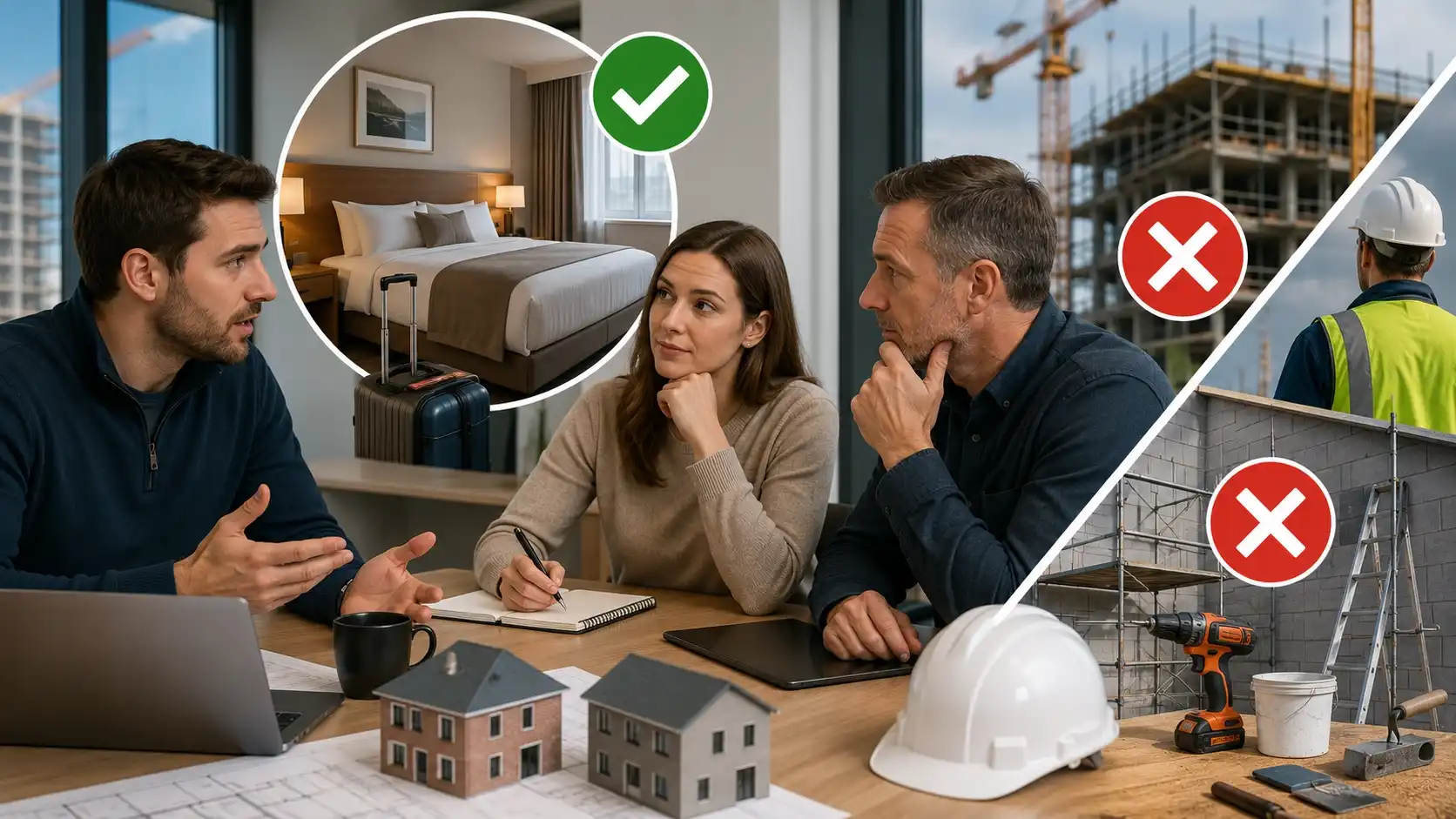
No. The VAT domestic reverse charge for building and construction services covers construction operations, building, altering, repairing, installing systems, site clearance, scaffolding and similar. Providing somewhere to sleep is not a construction operation, so accommodation is invoiced with VAT in the normal way.
The same logic applies to CIS. The Construction Industry Scheme catches payments for construction operations; it doesn’t catch an accommodation invoice. No CIS deduction should be applied to a bed.
This trips people up regularly: a subcontractor assumes the reverse charge applies, doesn’t pay the VAT across, and creates a problem for both parties. If an accommodation invoice arrives marked “reverse charge,” query it.
What payment terms should you expect?
Thirty days from invoice is the default where nothing else is agreed. Business-to-business contracts can go to 60 days by agreement, and beyond that only if the terms aren’t “grossly unfair” to the supplier. Public authorities are held to 30 days.
If an invoice runs late, the Late Payment of Commercial Debts (Interest) Act 1998 gives the supplier statutory interest at 8% above the Bank of England base rate. With base at 3.75% as of the July 2026 decision, that’s 11.75%, plus fixed compensation:
| Debt size | Fixed compensation |
|---|---|
| Under £1,000 | £40 |
| £1,000 – £9,999 | £70 |
| £10,000 and above | £100 |
Worth knowing in both directions. If you’re the buyer, it’s a reason to get POs raised early. If you’re a subcontractor waiting on reimbursement, it’s leverage.
For long bookings, monthly invoicing in arrears is standard and usually preferable to paying up front — it keeps the provider engaged on service quality for the duration of the stay.
How a 12-week crew booking should be invoiced
For a crew of eight over 84 nights, expect three monthly invoices rather than one lump sum or 12 weekly ones. A clean schedule looks like this:
| Invoice | Period | VAT treatment |
|---|---|---|
| 1 | Nights 1–30 | 20% on nights 1–28, reduced value from night 29 |
| 2 | Nights 31–60 | Reduced value throughout |
| 3 | Nights 61–84 | Reduced value throughout, plus any extras |
Each invoice should name the occupants and their arrival dates, because the 28-night clock runs per person, not per property. If someone joins the crew in week four, their own count starts then, and a provider who bills the whole property on one clock is getting it wrong in your favour or theirs, but rarely correctly.
Can contractors claim accommodation as an expense?
Generally yes, while the site qualifies as a temporary workplace, but the 24-month rule ends that, and it ends it earlier than most people expect.
A workplace stops being temporary once you know you’ll be there for more than 24 months and you spend 40% or more of your working time there. Both conditions have to be met.
The trap is the timing. Expenses stop being claimable from the moment you know the 24 months will be exceeded, not when the 24 months actually elapse. Eighteen months into a contract, a 12-month extension ends your claim on the day you sign it, with six months still to run before the threshold.
Two more points:
- Umbrella company workers face tighter restrictions, because supervision, direction and control rules generally block travel and subsistence relief on assignments.
- HMRC’s benchmark subsistence rates, £5, £10 and £25 with a £10 late supplement, cover meals and incidentals only. They never cover accommodation, which is budgeted and claimed separately.
Also worth knowing what you’re actually signing. A serviced apartment stay is normally a licence to occupy rather than a tenancy, which is why there’s no deposit protection scheme and why ending a stay is a notice period rather than an eviction.
What should be on the invoice?
A compliant VAT invoice needs more than a total. Missing fields are the most common cause of a payment run skipping an accommodation supplier.
- Supplier name, address and VAT registration number
- Sequential invoice number and invoice date
- Tax point and the period of supply (from/to dates)
- Customer’s exact legal entity name and registered address
- PO number where required
- Property address and named guest or guests
- Number of nights, rate per night, net total
- VAT rate applied and VAT amount — shown separately for nights 1–28 and nights 29+ if the reduced value rule applies
- Gross total, payment terms and bank details
That last VAT split is the one to insist on. If a provider bills a 90-night stay as a single line at 20%, you have no evidence the relief was applied and no easy way to query it.
Getting the paperwork right before mobilisation
Most accommodation disputes are administrative, not commercial. Five things settled in writing before anyone travels will prevent nearly all of them:
- The invoiced entity — full legal name, matched to the booking
- PO process — who raises it, when, and what it must reference
- Payment terms — 30 or 60 days, and what happens if they slip
- The VAT position — is the reduced value rule being applied from night 29?
- Notice and cancellation — the clause that costs most when a programme moves
It’s also worth pricing the options properly before you commit. Our guide to what site managers should budget per person per night covers regional rates and long-stay discounts, and the per-night cost breakdown of serviced apartments against hotels shows where the all-in numbers actually separate.
We handle this side of it daily. Guests House runs serviced apartments and whole houses across Somerset — Bridgwater, Taunton, Yeovil and Highbridge — plus Milton Keynes, with company invoicing, PO references and monthly billing on business and extended stays. Send us the entity details and dates and we’ll set the account up before your crew arrives.
FAQs
Who pays for contractor accommodation?
Usually the employing company, agency or main contractor rather than the individual, invoiced monthly against a PO. Limited-company contractors often book and expense it themselves.
Is there VAT on contractor accommodation?
Yes, 20% for the first 28 nights. From night 29 of a continuous stay by the same person, the reduced value rule brings the effective rate on the accommodation element down to around 4%.
Does the VAT reverse charge apply to accommodation?
No. The domestic reverse charge covers construction operations only. Accommodation is invoiced with VAT in the normal way.
Is contractor accommodation subject to CIS?
No. CIS applies to payments for construction operations, not to accommodation invoices. No deduction should be made.
What payment terms are standard?
Thirty days from invoice by default, extendable to 60 by agreement between businesses. Public authorities are held to 30 days.
What can I charge if an accommodation invoice is paid late?
Statutory interest at 8% above base rate — 11.75% with base at 3.75% — plus £40, £70 or £100 fixed compensation depending on the debt size.
Can I claim accommodation costs as a business expense?
While the site is a temporary workplace, yes. The 24-month rule ends the claim once you know you’ll exceed 24 months and spend 40%+ of your time there.
Do HMRC subsistence rates cover accommodation?
No. The £5, £10 and £25 benchmark rates cover meals and incidentals only. Accommodation is budgeted separately.