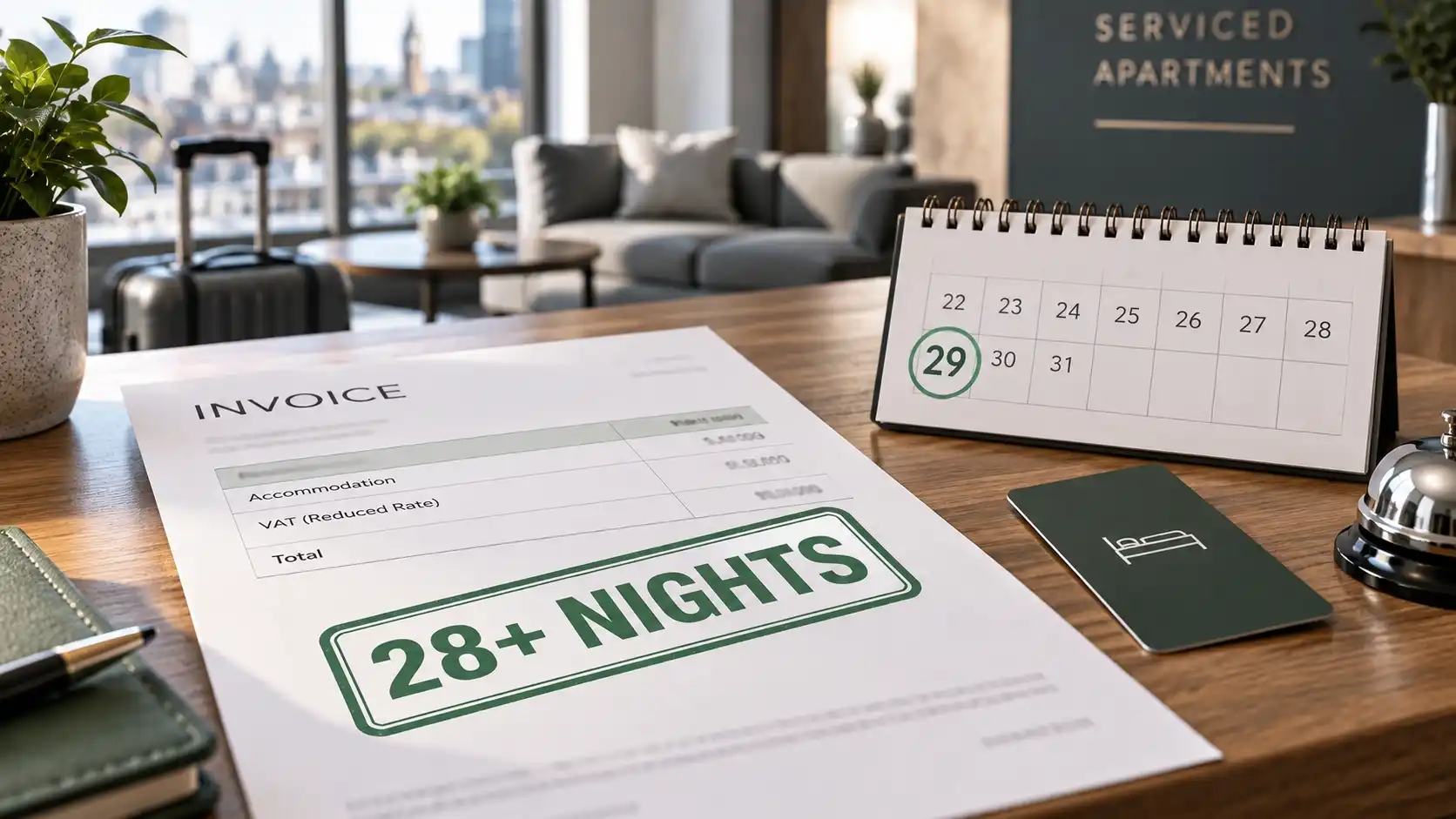
From night 29 of a continuous stay, VAT stops being charged on the bed. Only the “facilities” part of the nightly rate stays taxable, and that has to be at least 20% of the charge. Twenty per cent VAT on 20% of the rate is an effective 4% on the accommodation element.
That is the reduced value rule, and on a 90-night booking at £50 a night it takes £496 of VAT off one person’s stay. Across a crew of eight, close to £4,000.
It is also the most misapplied rule in long-stay accommodation: providers forget to switch it on, buyers assume it starts on day one, and one broken booking wipes it out. Here is how it works and what to ask before you book.
What is The Reduced Value Rule?
It sits in paragraph 9, Schedule 6 of the VAT Act 1994, and HMRC explains it in section 3 of VAT Notice 709/3. Despite the name, it is not a reduced rate and it is not a discount. The rate stays at 20% throughout. What changes is the value that rate is applied to.
For the first 28 days, VAT is due on the whole charge. From day 29 the supply is re-valued: the part of the payment relating to sleeping accommodation drops out, and VAT is charged only on what remains. HMRC sets a floor, at least 20% of the remaining charge must be treated as facilities, even in a property where you would struggle to name any. Where the genuine value of the facilities is higher, the higher figure applies.
So the nightly rate does not change. The tax on it collapses.
The Maths on a 90-Night Booking
One person, one apartment, one continuous booking at £50 a night excluding VAT.
| Nights 1–28 | Nights 29–90 | Total | |
|---|---|---|---|
| Net accommodation | £1,400 | £3,100 | £4,500 |
| Taxable value | £1,400 | £620 | £2,020 |
| VAT at 20% | £280 | £124 | £404 |
| Gross payable | £1,680 | £3,224 | £4,904 |
Billed at 20% throughout, the same stay costs £5,400 gross. The relief is worth £496 per person, a little over 9% of the total bill.
Gross cost, 90 nights at £50/night net

Reduced value applied  ██████████████████░░   £4,904
20% VAT throughout     ████████████████████   £5,400
The saving lands entirely in the back end. Nights 29 onward cost £52 gross instead of £60, night 29 is cheaper than night 1, and everything after it stays cheaper.
Why “It Drops to 4%” Is Only Half The Story
That figure is right about the accommodation element from day 29. It is misleading about your bill, because the first 28 nights are always charged in full and never come back.
What matters commercially is the blended rate across the whole stay:
| Length of stay | Total VAT on £50/night net | Blended VAT rate | Saved vs 20% throughout |
|---|---|---|---|
| 30 nights | £284 | 18.9% | £16 |
| 60 nights | £344 | 11.5% | £256 |
| 90 nights | £404 | 9.0% | £496 |
| 180 nights | £584 | 6.5% | £1,216 |
| 12 months | £954 | 5.2% | £2,696 |
A 30-night stay barely registers. The rule only pays properly past the two-month mark, worth knowing before it goes into a budget for a six-week job.
One more wrinkle: where the rate includes food, the food is stripped out first and stays standard-rated in full. On a £90 hotel rate including a £10 breakfast, day 29 onward carries £2 VAT on the breakfast plus £3.20 on facilities, an effective 5.8%, not 4%. Self-catering serviced apartments, compared with hotels per night, land nearer the clean figure because there is no meal element to carve out.
The Four Conditions
All four must hold. Three of them are routinely missed.
| Condition | What it means in practice |
|---|---|
| More than 28 days | The relief applies to the excess. Day 29 onward, never earlier |
| The same individual | One named person occupying throughout. Not “the room” |
| Continuous occupation | One unbroken stay, not a run of weekly bookings |
| A qualifying establishment | Hotel, guest house, hostel or serviced flat, not accommodation for permanent residential use |
The one that surprises people: who pays is irrelevant. HMRC is explicit that a company, agency or local authority can pay the bill and the relief still applies, provided one individual occupies the accommodation throughout. A company booking only fails when it is used as a hot bed, a succession of different people each staying under 29 days. Rotate three site engineers through one apartment over a quarter and nobody qualifies, however long the booking runs.
The other trap is the establishment test. A property let under a formal tenancy is a different supply, usually exempt from VAT rather than reduced.
That sounds better until you look at what else changes. A serviced apartment stay is normally a licence to occupy rather than a tenancy, which is why it stays flexible, stays serviced, and stays inside the VAT system where the reduced value rule can apply at all.
Weekends Home, Rotations and The Retaining Fee
This is where contractor bookings usually go wrong, and where the money is.
Continuity does not mean the person never leaves the building. HMRC accepts that a long-term resident away for the occasional weekend or holiday does not restart the clock, and neither does an absence covered by a retaining fee, where the room is held and paid for while empty.
What breaks it is a regular pattern of release. A Monday-to-Thursday booking, checked out every Friday and rebooked every Monday, is a series of short stays. Thirty weeks of that qualifies for nothing.
For rotational crews the answer is usually the same: book the unit continuously for a named person, pay a reduced retaining rate for the off nights, and keep the key. You are paying for nights nobody sleeps in, so run it both ways, on a 2-on/1-off rotation the retained nights often cost less than the VAT they recover, but not at every rate. Confirm the treatment in writing before you commit.
Day 29, Not Day 1, and Never Backwards
Two mistakes, both expensive.
Applying it early. Even when everyone knows on day one that the booking runs 120 nights, VAT is due in full for the first 28. A provider who reduces from the outset has under-declared output tax, and it becomes your problem when your input tax claim is reviewed.
Expecting it backwards. Passing day 29 does not reopen the first 28 nights. There is no retrospective adjustment.
On the invoice it shows up one of two ways: monthly billing in arrears with a split on the first invoice, 20% to night 28, reduced value from night 29, or full VAT followed by a credit note once the stay crosses the threshold. Both are legitimate; the first is cleaner to audit.
Advance payments complicate this: a payment received creates a tax point before the 28 days have run. It is one reason long stays are billed monthly in arrears, alongside the wider question of how contractor accommodation should be invoiced — entity names, PO references and payment terms.
Who Actually Saves the Money?
Not everyone, and this is the part providers skate over.
| Your position | What the relief is worth |
|---|---|
| VAT-registered, fully taxable | Cashflow only, you were reclaiming the input tax anyway. |
| Not VAT-registered | Real cash. The VAT is a sunk cost to you. |
| Partly exempt or exempt | Real cash on the irrecoverable proportion. |
| Individual paying personally | Real cash, in full. |
Reclaiming input tax on the whole bill? The rule improves your working capital and nothing else. A subcontractor under the £90,000 registration threshold, an NHS trust, a charity, an insurer or a contractor paying personally keeps that £496.
Then the question nobody asks. Is the provider passing it on? If your rate was quoted net plus VAT, the saving reaches you automatically. If it was quoted as a single gross all-in figure, the relief improves the provider’s margin from night 29 and your cost does not move. Ask which basis you are on before you book, not when the second invoice arrives.
Why Some Providers Never Apply It
- The booking system was never configured to switch at night 29. Mundane, and the most common cause by far.
- The provider operates the Tour Operators’ Margin Scheme. Agents and resellers account for VAT on their margin; the reduced value rule does not apply inside TOMS, and you cannot reclaim VAT on a TOMS invoice either. The 2025 Upper Tribunal decision in Sonder Europe moved several lease-and-sublet operators out of TOMS and has been appealed further, so ask each provider directly.
- The stay was placed as weekly bookings to preserve flexibility. That flexibility now has a price attached.
- Extras are billed as accommodation. Parking, laundry, mid-stay cleans and equipment hire are separate supplies and stay standard-rated in full.
Six Questions to Ask Before You Book
- Do you apply the reduced value rule from night 29, and will it show as a separate line on the invoice?
- Is my rate quoted net plus VAT, or gross inclusive?
- Are you the principal, or invoicing under TOMS?
- If my occupant goes home at weekends, how are those nights treated?
- What happens to the VAT position if I swap the named occupant mid-booking?
- Will you invoice monthly in arrears?
Six answers in writing before mobilisation will save more than negotiating a pound off the nightly rate.
Guests House runs serviced apartments and whole houses across Somerset – Bridgwater, Taunton, Yeovil and Highbridge – plus Milton Keynes, with named-occupant bookings, monthly invoicing and the VAT split shown on every invoice for business and extended stays. Send us the dates and the names and we will set the account up before anyone travels.
FAQs
Is there VAT on stays over 28 days?
Yes, but far less of it. From night 29 of a continuous stay by the same person, VAT is charged only on the facilities element, at least 20% of the charge, giving an effective rate of about 4% on the accommodation.
Does the 28-day rule apply from day one if I book 90 nights up front?
No. VAT is due in full on the first 28 nights however long the booking is. The relief runs from night 29 and cannot be backdated.
Do company bookings qualify?
Yes, provided the same individual occupies the accommodation throughout. What fails is a booking used by a succession of people each staying under 29 days.
Does going home at weekends break the stay?
Not necessarily. Occasional absences are ignored, and a retaining fee holding the room while it is empty preserves continuity. A regular weekly check-out and rebooking does break it.
What counts as the facilities element?
Everything other than the right to occupy the sleeping accommodation, cleaning, utilities, furniture, reception and similar. At least 20% of the charge must be treated this way, or more where the genuine value is higher.
Does the rule apply to serviced apartments?
Yes. HMRC’s definition of a similar establishment includes serviced flats, other than those provided for permanent residential use.
Are meals covered by the relief?
No. Food is separated out first and stays standard-rated in full, which is why a hotel B&B rate lands nearer 6% than 4% after day 29.
What if I move to a different apartment mid-stay?
Ask before you move. A room change within the same establishment is normally treated as continuing; a move to a different property is generally a new stay with a new 28-day clock.