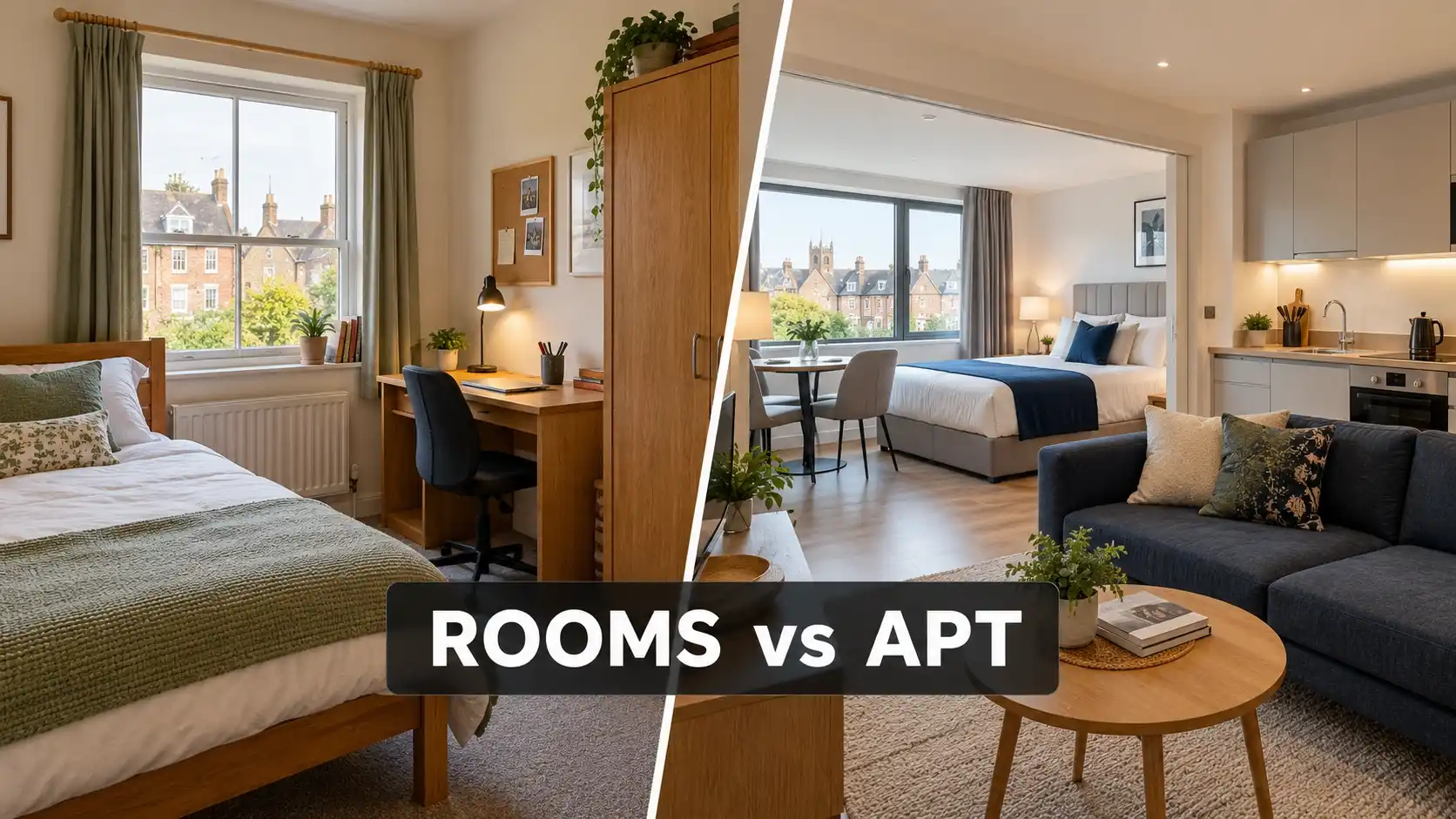

Three options cover almost every construction package: digs (a room in someone’s house or a shared HMO), a hotel, or a serviced apartment or contractor house.
Here’s what most people get wrong. Digs used to be obviously the cheapest, but with the UK average room now at £761 a month and long-stay apartment discounts running 20–30%, the two have converged. On a twelve-week package the difference can be under £1,000 across a crew of six.
Which means price is no longer the deciding factor. Compliance, admin and whether your crew turns up rested are.
What are the three options, really?
| Digs / HMO room | Hotel | Serviced apartment or contractor house | |
|---|---|---|---|
| Typical cost | £550–£770 per room, per month | £70–£100 per night | £25–£40 per person per night |
| Booked by | The worker, usually | Company or worker | Company, usually |
| Minimum term | Often monthly | 1 night | 2–7 nights |
| Kitchen | Shared | None | Private |
| Parking | Street, usually | £10–£25 extra | Usually included |
| Who’s liable for safety | The landlord | The hotel | The operator |
| Admin per booking | High | Low | Low |
| Best for | Solo workers, long local stays | 1–3 nights, short notice | Crews, 1 week to 12 months |
What are digs, and are they still worth it?
“Digs” covers two different things, and the distinction matters more than the word suggests.
A lodger rents a room in a house where the landlord also lives. That landlord can earn £7,500 a year tax-free under the Rent a Room scheme, which is why the market exists at all. An HMO room is a room in a shared house where the landlord doesn’t live, a very different legal animal, with licensing attached.
Current room rents give you the benchmark:
| Region | Average monthly room rent |
|---|---|
| UK average | £761 |
| England | £767 |
| South West | £678 |
| South East | £703 |
| West Midlands | £587 |
| North West | £614 |
| Yorkshire & Humberside | £569 |
| London | £915 |
Those are Q2 2026 figures, and the more useful number alongside them is supply, down 3.2% year on year. Rooms are getting harder to find, not cheaper.
Digs work well for a solo worker on a long local posting who wants the lowest possible outlay and doesn’t mind sharing a kitchen. They work badly for crews, for anyone on nights, and for any company that needs an invoice.
The failure modes are consistent: no company invoice, no single point of contact when something breaks, no control over who else is in the house, and a landlord under no obligation to accommodate a shift pattern. On a package where the end date might move, you’re also negotiating six separate exits rather than one notice period.
The HMO question site managers should ask
If you’re putting five or more people from two or more households into one property, that’s a mandatory licensable HMO in England. This is where informal arrangements quietly become somebody’s legal problem.
What a licensed HMO must have:
- Bedrooms of at least 6.51 m² for one person, 10.22 m² for two. Anything under 4.64 m² can’t be used for sleeping at all.
- Interlinked, mains-powered smoke and heat alarms.
- FD30 fire doors rather than standard internal doors.
- An annual gas safety certificate, notified to the council.
- A licence stating the maximum permitted occupants, exceeding it needs written approval.
Operating without a required licence carries criminal prosecution or a civil penalty of up to £30,000, plus rent repayment orders of up to twelve months’ rent per tenant.
The practical version for a site manager: if a subcontractor tells you they’ve “sorted a house for the lads,” ask whether it’s licensed and how many are staying in it. You don’t want to find out after an incident.
When do hotels make sense for construction crews?
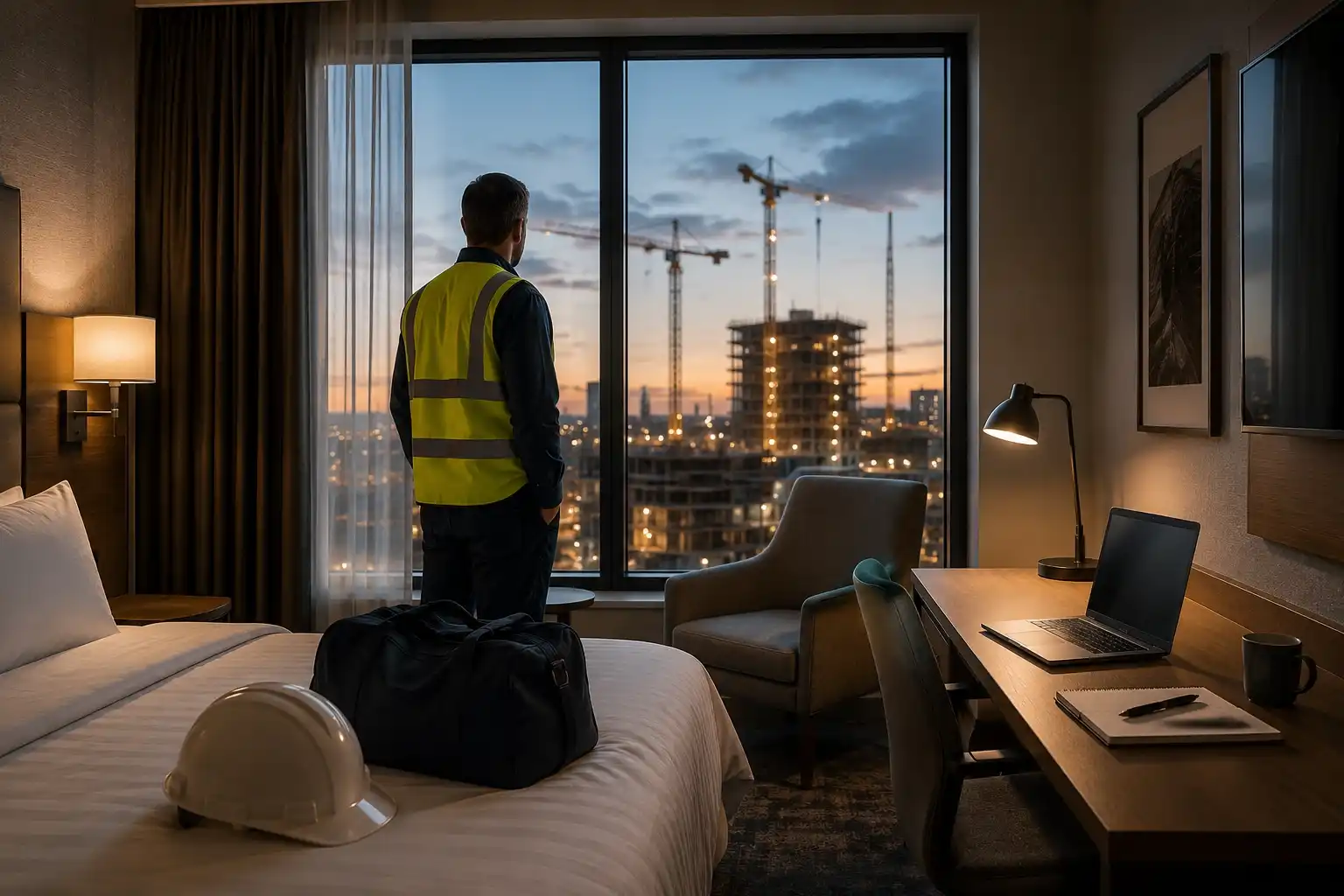
Short visits and short notice. One to three nights, an audit, a commissioning visit, a client walk-round, book the hotel and move on. Nothing else is worth the admin.
They stop making sense fast. The UK average hotel rate was £124.48 a night in January 2026, and budget chains still land at £40–£80 before breakfast and parking. Add an evening meal and you’re at £110–£140 per person per night with no kitchen, no laundry and no drying space.
There’s a practical problem too. Hotels aren’t built for 6am starts and 8pm finishes. Breakfast service ends before your crew leaves, the kitchen closes before they get back, and there’s nowhere to dry wet workwear.
When is a serviced apartment or contractor house right?
From roughly the fourth or fifth night, and almost always for crews. You’re renting space rather than keys, which changes the per-head maths completely, six people in one three-bedroom house beats six hotel rooms by a wide margin.
What you’re actually buying beyond the bed:
- A kitchen, worth around £30 a day per person in avoided food spend.
- Parking on the property, which matters enormously near constrained sites.
- A washing machine, which removes hotel laundry charges entirely.
- Self check-in, so a 10pm arrival after a delayed shift isn’t a problem.
- One invoice for the whole crew, to the company, with a PO reference.
It’s also a licence to occupy rather than a tenancy, no deposit protection scheme, no AST, just a notice period. Our guide to what a serviced apartment includes as standard covers that distinction properly.
The real cost comparison
Take a crew of six on a twelve-week package, 504 person-nights, in a regional UK location.
| Option | Effective rate | Total |
|---|---|---|
| Digs (6 rooms, ~2.8 months at South West average) | ~£22.60 per night | ~£11,400 |
| Contractor house at long-stay rate | £22.50 per person per night | ~£11,340 |
| Same, with the 28-day VAT relief applied | ~£20.50 blended | ~£10,300 |
| Budget hotel plus breakfast | £82 per night | ~£41,300 |
Cost of housing 6 workers for 12 weeks

Contractor house + VAT relief  █████░░░░░░░░░░░░░░░   £10,300
Contractor house, long-stay    █████░░░░░░░░░░░░░░░   £11,340
Digs (6 separate rooms)        █████░░░░░░░░░░░░░░░   £11,400
Budget hotel                   ████████████████████   £41,300
Two conclusions worth sitting with. First, the hotel option costs roughly four times the alternatives, it isn’t a close call on any package longer than a week. Second, digs and managed accommodation now cost about the same, so choose on the things that aren’t price.
That VAT line is worth understanding. Where the same person stays continuously for more than 28 nights, a reduced-value rule cuts the effective VAT on the accommodation element to around 4% from night 29. It only applies to one continuous booking in one name, weekly renewals don’t qualify.
The hybrid most experienced managers actually use
Few well-run packages use one option for everybody. The pattern that works:
- Site manager and supervisors in a one or two-bed apartment, own kitchen, own front door, somewhere to take a call at 7am
- The crew in a three to five-bedroom house together, cheaper per head, and they cook and travel as a unit
- Visiting staff and auditors in a hotel for their one or two nights
It costs marginally more than putting everyone in one house and it removes most of the friction, no supervisor sharing a bathroom with the people they’re managing, no one-night visitor disrupting a settled crew.
For a fuller breakdown by region, see our guide to what site managers should budget per person per night.
What doesn’t show up in the price
This is where packages actually go wrong, and none of it appears on a quote.
- Shift patterns. Night crews need daytime quiet and a mid-week linen change. Digs rarely accommodate either.
- Drying space. Wet workwear with nowhere to dry means damp kit on day two and a demoralised crew by day five.
- Tool security. A locked garage or a driveway you can reverse a van onto is worth real money.
- Fatigue. A long commute plus poor sleep is a safety issue on site, not a comfort issue.
- Turnover risk. Bad accommodation is one of the most common reasons workers leave a package early, and replacing a skilled operative mid-programme costs far more than the nightly rate you saved.
- Availability near big projects. Around major schemes, local supply is taken weeks ahead. It’s exactly what happens with contractor accommodation near Hinkley Point C, where two campuses hold about 1,500 beds against a far larger on-site workforce.
Choosing the right option for your package
Run it in this order and the answer is usually obvious:
- How many nights? Under four, hotel. Over seven, apartment or house.
- How many people? Two or more travelling together, take a whole property.
- Who’s paying? If the company needs an invoice and a PO, digs are the wrong tool.
- What shift? Nights or early starts rule out most hotels and most digs.
- Is the end date firm? If not, check the notice period before you check the rate.
- Is it compliant? For any shared house, ask about HMO licensing in writing.
We handle the crew end of this daily. Guests House runs serviced apartments and whole houses from one-beds up to five-bedroom properties sleeping ten, across Somerset, Bridgwater, Highbridge, Taunton and Yeovil, plus Milton Keynes. Parking, full kitchens, laundry, self check-in and company invoicing on extended stays. Send a postcode, dates and headcount and we’ll tell you straight whether we can cover it.
FAQs
What is the cheapest accommodation for construction workers?
On long stays, digs and contractor houses are now roughly level — around £11,000–£11,400 for six workers over twelve weeks. Hotels cost about four times that.
What are digs for contractors?
A rented room, either as a lodger in a landlord’s own home or a room in a shared HMO. Cheap and simple for solo workers, awkward for crews and company invoicing.
Do contractors need an HMO licence?
The landlord does, where five or more people from two or more households share a property. Penalties reach £30,000 plus rent repayment orders.
What are the minimum room sizes in an HMO?
6.51 m² for one person and 10.22 m² for two. Rooms under 4.64 m² cannot be used for sleeping.
How much is a room to rent in the UK?
£761 a month on average as of Q2 2026, £678 in the South West, £703 in the South East and £915 in London.
Are hotels ever the right choice for site teams?
Yes, for one to three nights or genuine short notice. Past a week the cost and the lack of a kitchen make them hard to justify.
Does VAT drop on long contractor stays?
From night 29 of a continuous stay by the same person, the reduced-value rule takes effective VAT on the accommodation element down to roughly 4%.
What should I check before booking crew accommodation?
Parking spaces, notice period, invoicing terms, drying and laundry facilities, and HMO licensing for any shared house.