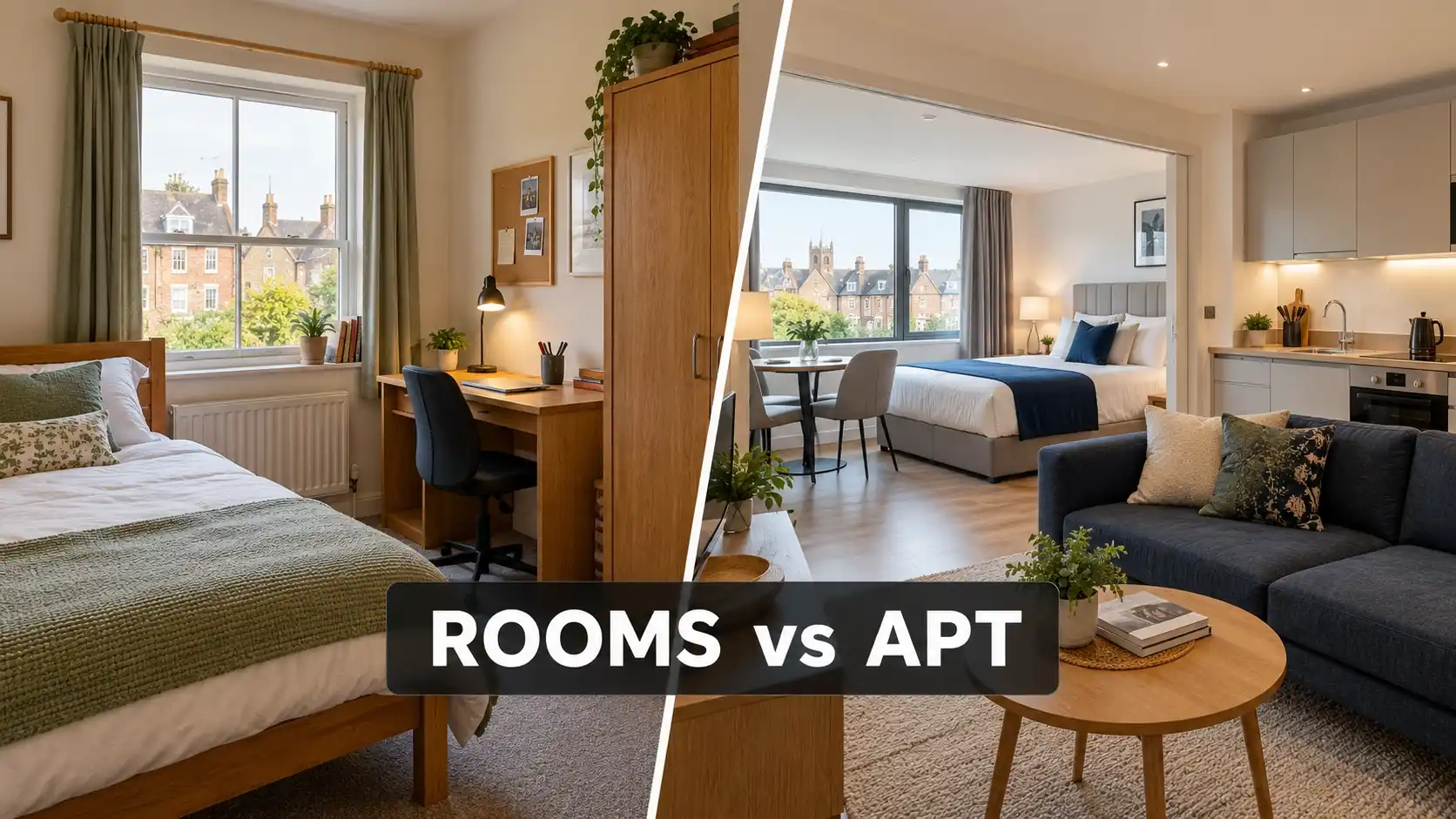

Corporate housing is one of the few lines in a mobility budget where the cheapest rate is regularly the most expensive decision. A nightly price tells you almost nothing about whether the property is safe, whether the provider will answer the phone at 11pm, whether the invoice will survive an audit, or whether the stay can end early without a penalty.
2026 has also moved the ground under UK buyers. The Renters’ Rights Act removed fixed-term tenancies for individuals in May, a national short-let register is due by March 2027, and new planning powers could change which properties remain available at all.
This guide is written for the person who has to sign off the programme: what UK corporate housing is, when it beats a hotel or a tenancy, how to buy it, what to check, what it costs, how tax shapes the policy, and what belongs in a rate agreement.
What is corporate housing in the UK?
Corporate housing is furnished, fully equipped accommodation booked by an employer for stays of roughly a month to a year or more, usually for relocations, assignments, project work and secondments. In the UK the term overlaps heavily with serviced apartments, and buyers use the words loosely.
The practical distinctions:
| Type | Typical stay | Contract | Services | Best for |
|---|---|---|---|---|
| Serviced apartment | 2 nights to 12 months | Licence to occupy | Weekly housekeeping, bills included | Projects, interim roles, early relocation |
| Aparthotel | 1 night to 3 months | Licence | Front desk, daily or weekly cleaning | City-centre business travel |
| Corporate housing | 30 days to 12 months+ | Licence, sometimes a company let | Fortnightly cleaning or on request | Relocations, families, longer assignments |
| Corporate letting | 6 to 24 months | Tenancy to the company | None | Long, fixed assignments with a firm end date |
The point that matters for policy is the contract. Most corporate housing is booked on a licence to occupy, not a tenancy, which is what makes short notice periods and all-inclusive pricing possible. Our plain guide to what a serviced apartment is sets out the licence model and the questions HR teams most often ask about it.
How big is the UK corporate housing market in 2026?
There are around 56,700 serviced apartments across the UK, generating about £1.7 billion a year, and roughly half of them operate under a recognised brand. That is the figure from the independent review of the sector carried out for the Association of Serviced Apartment Providers.
Three trends from 2025 and 2026 are worth knowing before you negotiate:
- Supply is still growing, mostly in London. HVS’s July 2026 review of the European sector puts the UK at about 22% of the European branded pipeline, around 4,356 units, with 57% of new UK supply concentrated in the capital.
- Occupancy is high but softening. Occupancy across European markets ran at roughly 80% in 2025. In London, occupancy edged up but average rates declined; outside London, occupancy pulled back more sharply.
- That makes 2026 a reasonable year to negotiate, particularly outside London, where operators have more inventory to fill on long stays.
When should a mobility policy use corporate housing instead of a hotel or a rental?
Use a hotel for up to about four or five nights, corporate housing from a week up to roughly nine months, and a corporate letting or the employee’s own tenancy beyond that. Length of stay is the variable that decides almost everything else.
| Length of stay | Usual best fit | Why |
|---|---|---|
| 1 to 4 nights | Hotel | Simplest, daily service, no minimum stay |
| 5 nights to 4 weeks | Serviced apartment | Kitchen, space and all-in pricing start to beat hotel extras |
| 1 to 9 months | Corporate housing | Long-stay discounts, flexible notice, no setup or exit costs |
| 9 to 24 months, firm dates | Corporate letting | Lower monthly cost once furnishing and setup amortise |
| Permanent move | Employee’s own tenancy or purchase | The employee becomes the customer |
On all-in cost, apartments typically pull ahead of hotels from about the fourth or fifth night, because the extras a hotel bills separately, such as laundry, breakfast and parking, are already inside the rate. Our breakdown of the real per-night cost of serviced apartments versus hotels runs that comparison line by line.
Three factors should override the length-of-stay rule:
- Families almost always need corporate housing earlier, because a hotel room does not work for children for more than a few nights.
- Uncertain end dates favour a licence with short notice over any tenancy.
- Rotating occupants, where a seat passes between employees, favour corporate housing or a corporate letting with an occupier substitution clause.
What changed for corporate housing buyers in 2026?
Three regulatory changes landed or were confirmed in 2026, and together they push more relocations towards corporate housing and put more scrutiny on where that housing comes from.
1. Fixed-term tenancies for individuals ended on 1 May 2026. The Renters’ Rights Act 2025 abolished assured shorthold tenancies and fixed-term assured tenancies in England. New tenancies are periodic, tenants can leave on two months’ notice, and restrictions on rent in advance have removed the old workaround of pre-paying months of rent for a new arrival with no UK credit history. Lettings to companies sit outside the regime, which is why corporate lettings and corporate housing are now the two routes that can still deliver a defined term. Our comparison of corporate lettings versus serviced apartments for a six-month assignment works through the costs and risks of each.
2. A national short-let register is due by March 2027. The Culture Secretary confirmed in September 2026 that England’s short-term lets register will be fully operational by March 2027, with a registration number required on listings and safety evidence expected from hosts.
3. A new planning use class is coming. The proposed C5 short-term let use class would let councils require planning permission for converting homes to short lets in designated areas. Much UK serviced apartment stock already sits in the C1 hotel use class, but some providers operate from ordinary residential flats.
The implication for buyers is supply quality, not just supply volume. Ask every provider how its properties are classified in planning terms and how it is preparing for registration. A programme built on stock that becomes unlawful to let is a programme you rebuild at short notice.
How do you buy corporate housing: direct, agent or relocation company?
There are four routes, and the right one depends on how many cities you need, how much volume you have, and who you want holding the duty-of-care paperwork.
| Route | How it works | Strengths | Watch for |
|---|---|---|---|
| Direct with an operator | You contract with the company that runs the properties | Best rates on volume, one relationship, direct accountability | Limited to that operator’s locations |
| Booking agent or aggregator | An agent sources from many operators, usually paid by commission built into the rate | Wide coverage, one point of contact, quick sourcing | Variable standards across suppliers; check who vets what |
| Relocation management company | Housing sits inside a wider relocation package | Integrated with visas, destination services and policy | Housing may be a small, marked-up part of the service |
| Travel management company | Booked through your existing travel programme | Policy enforcement, consolidated data | Often stronger on hotels than on long stays |
Most mature programmes end up hybrid: direct agreements in the two or three cities with the heaviest volume, and an agent or relocation company for everywhere else. The direct agreements give you price and accountability where you spend the most; the agent gives you coverage where volume does not justify a contract.
Whichever route you choose, write down who is responsible for checking safety documentation. “The agent vets suppliers” is not a duty-of-care position until you have seen what that vetting covers.
What should you check before approving a corporate housing provider?
Start with duty of care, because it is the part you cannot delegate. Under the Health and Safety at Work Act 1974, an employer must take reasonable steps to protect employees, and that extends to where they sleep on a work assignment.
ISO 31030:2021, the international standard for travel risk management published in January 2021, is guidance rather than a certifiable standard, but it is the clearest statement of what “reasonable” looks like. It expects organisations to assess the suitability of accommodation types in each destination rather than defaulting to the cheapest option, and to recognise that insurance alone does not discharge the duty.
Accreditation: what ISAAP actually checks
The UK’s established accreditation for serviced accommodation is ISAAP, the International Serviced Accommodation Accreditation Process. It was created by the Association of Serviced Apartment Providers, has been run by Global Secure Accreditation since September 2021, and remains ASAP’s preferred quality and safety assessment body. It assesses quality, health and safety, hygiene, security and compliance, and accredited providers can be checked through its verification system.
Core compliance checks under the scheme include fire risk assessments, smoke alarms and kitchen fire blankets, carbon monoxide testing where relevant, gas safety certificates, appliance inspections, public and employer’s liability insurance, lift servicing, and accessibility information.
Accreditation is a strong filter, not a guarantee. Use it to shortlist, then verify the documents yourself for the properties you actually book.
The documents to request
| Document | Why it matters |
|---|---|
| Written fire risk assessment | The Regulatory Reform (Fire Safety) Order 2005 applies to paid guest accommodation, and since 1 October 2023 the assessment must be recorded in full in writing |
| Gas safety record | Annual check by a Gas Safe registered engineer |
| Electrical safety evidence | A current electrical installation report and appliance testing |
| Smoke and carbon monoxide alarms | Tested, in place, and covered by the fire risk assessment |
| Insurance certificates | Public and employer’s liability, and buildings cover suitable for paid accommodation |
| Security arrangements | Key or code management, access control, how codes change between guests |
| 24/7 support and escalation | A named route for out-of-hours emergencies, with response times |
| Data protection terms | You share assignees’ personal data; a data processing agreement should cover it |
| Planning and registration position | Use class and readiness for the 2027 register |
A provider that cannot produce these within a day or two for a specific property is telling you something about how it runs.
What does corporate housing cost in the UK?
Expect roughly £45 to £130 a night for a one-bedroom apartment outside London, and anything from about £950 to £2,450 a week for a one-bed in London on a stay of two weeks or more, with long-stay discounts on top.
| Market | One-bedroom benchmark | Source and basis |
|---|---|---|
| Central London | £950 to £2,450 a week | One London operator’s 2026 pricing for 14+ night stays, by area |
| London studio | £800 to £1,610 a week | Same basis |
| Manchester | From about £80 a night | Published 2026 entry rates |
| Milton Keynes | £85 to £130 a night | Our 2026 market rates |
| Somerset | £45 to £95 a night | Our 2026 market rates, Bridgwater and Taunton |
Treat these as planning benchmarks. Rates in any city swing by season, events and how far ahead you book.
Long-stay pricing is where a programme makes or loses money, because operators discount duration far more readily than volume:
| Nights booked | Typical discount |
|---|---|
| 7+ | 5 to 10% |
| 14 to 20 | 10 to 15% |
| 30+ | 15 to 25% |
| 90+ | 20 to 30% |
The costs that do not appear in the headline rate are where comparisons fall apart. Check, for every quote:
- Parking, which can add £10 a day or more in city centres
- Cleaning frequency, and the cost of extra cleans
- Early departure terms, because assignments end early more often than they extend
- Utilities caps, which some long-stay providers apply
- Damage deposits and how quickly they are returned
How should tax and VAT shape a corporate housing policy?
Three rules do most of the work: the £8,000 relocation exemption, the temporary workplace rules, and the reduced VAT rate on long stays.
Relocation exemption. Qualifying relocation expenses and benefits of up to £8,000 per move are exempt from tax and National Insurance. Qualifying costs include travel and subsistence, and the legislation defines subsistence as “food, drink and temporary living accommodation” (section 281(6), Income Tax (Earnings and Pensions) Act 2003). Costs must be met before the end of the tax year after the one in which the employee started the new role, and amounts above the limit are reportable. In practice, temporary housing competes with removals, legal fees and other moving costs for the same £8,000, so a long corporate housing stay can exhaust the allowance on its own.
Temporary workplace rules. Accommodation for an employee working at a temporary workplace is generally allowable, but the relief fails once a posting is expected to exceed 24 months at that location. Assignments that extend in stages are the usual way this goes wrong.
VAT on long stays. Serviced accommodation is standard rated, but where the same person stays continuously for more than 28 nights, a reduced value rule applies from night 29, bringing the effective VAT on the accommodation element down to roughly 4%. Our explainer on the reduced value rule for stays over 28 days shows how to book so that it applies. For VAT-registered businesses that can recover input tax on business accommodation, the headline VAT is often not a net cost anyway; for those that cannot, the rule is worth real money.
None of this is tax advice, and the interaction between relocation policy, benefit-in-kind rules and an individual’s circumstances is worth a specialist’s review before the policy is published.
What should a corporate housing rate agreement include?
Price is one line. The clauses that decide whether the programme works are notice, flexibility, service levels and evidence. Use this as a checklist for an RFP or a direct agreement:
- Rate structure. Fixed annual rates, or a percentage discount off dynamic rates, with length-of-stay tiers spelled out
- Availability commitments. Whether your rate holds when the operator’s occupancy is high, or only when it has rooms to spare
- Notice and early departure. Seven to 30 days is normal on a licence; avoid paying for unused weeks on a cut-short assignment
- Extensions. Guaranteed extension at the same rate, or first refusal, so a two-month stay can become four without a move
- Occupier substitution. The right to change the named guest, and how that interacts with the 28-day VAT clock
- Invoicing and payment terms. Consolidated monthly invoicing, purchase order references, cost centre coding and 30-day terms
- VAT treatment. Confirmation that the reduced value rule will be applied from night 29 on qualifying stays
- Service levels. Response times for maintenance, out-of-hours emergencies and guest issues, with a named escalation route
- Duty-of-care evidence. Accreditation status and the right to request property-level safety documents on demand
- Data protection. A data processing agreement covering assignee personal data
- Reporting. Monthly data on nights, spend, length of stay, issues and guest feedback
- Sustainability and accessibility. EPC ratings, accessible units, and pet and family policies if your population needs them
- Review and exit. Annual rate review, performance triggers, and a clean exit if standards drop
Agreements that skip clauses 3, 4 and 8 tend to look cheap at signature and expensive by the third month.
How do you know whether a corporate housing programme is working?
Track a small set of measures monthly, and compare them against what the same stays would have cost in hotels.
| Measure | What it tells you |
|---|---|
| Effective nightly rate after discounts | Whether negotiated rates are actually landing |
| Average length of stay | Whether the policy is routing the right stays to corporate housing |
| Share of nights with accredited providers | Your duty-of-care exposure |
| Issue resolution time | Whether service levels are real |
| Assignee satisfaction | Whether people are productive in week one |
| Extension rate | How often assignments outrun their housing, and what that costs |
| Saving against hotel baseline | The number your finance director will ask for |
A good provider should produce most of this for you. If they cannot, that is information too.
What are the most common corporate housing mistakes?
- Buying on nightly rate alone. The cheapest quote with the worst notice clause is the most expensive booking you will make this year.
- Assuming the agent has checked safety. Ask to see what the vetting covers, in writing.
- Rolling weekly bookings instead of one continuous stay, which forfeits both long-stay discounts and the reduced VAT rate.
- Forgetting the £8,000 is shared. Temporary housing and removals draw on the same relocation exemption.
- No plan for early endings. Assignments are cut short more often than they run long.
- Ignoring planning status. A property that cannot lawfully operate after 2027 is a relocation you redo.
- Measuring nothing. Without data, every renewal is a negotiation from scratch.
Where can you book corporate housing in Somerset and Milton Keynes?
Guests House runs serviced apartments and whole houses across Somerset and Milton Keynes, with parking, full kitchens, laundry, fast Wi-Fi and self check-in. For mobility and HR teams we invoice companies directly with PO references, apply the reduced value rule on qualifying long stays, share property-level safety documents on request, and step the rate down as the booking lengthens through our business and extended stay rates. If you are building or reviewing a programme, get in touch and we will answer the checklist above for any property you are considering.
Corporate housing UK: FAQs
What is corporate housing?
Furnished, fully equipped accommodation booked by an employer for stays of around a month to a year or more, usually for relocations, assignments and project work. In the UK it is normally booked on a licence to occupy rather than a tenancy.
Is corporate housing the same as a serviced apartment?
They overlap. Serviced apartments cover stays from a couple of nights; corporate housing usually refers to longer stays of 30 days or more, often with less frequent cleaning and more home-like space.
How much does corporate housing cost in the UK?
Roughly £45 to £130 a night for a one-bedroom apartment outside London, and around £950 to £2,450 a week for a one-bed in central London on a stay of two weeks or more, before long-stay discounts.
How long is a typical corporate housing stay?
Usually between one and nine months. Shorter stays tend to suit hotels or serviced apartments; longer, fixed stays often suit a corporate letting.
Is corporate housing a tenancy?
Normally no. It is usually a licence to occupy, which allows short notice periods and all-inclusive pricing. A corporate letting, where the company signs a tenancy, is a different arrangement.
What accreditation should a UK corporate housing provider have?
ISAAP accreditation is the established scheme for serviced accommodation in the UK, covering quality, health and safety, hygiene, security and compliance. Use it to shortlist, then request property-level safety documents.
What duty of care does an employer owe for corporate housing?
Under the Health and Safety at Work Act 1974 an employer must take reasonable steps to protect employees, including their accommodation on work assignments. ISO 31030 sets out good practice for assessing accommodation suitability.
Is temporary accommodation covered by the relocation tax exemption?
Yes, within limits. Qualifying relocation costs up to £8,000 per move are exempt, and the legislation defines subsistence as including temporary living accommodation. The same £8,000 covers removals and other qualifying costs.
Do long corporate housing stays get a VAT reduction?
Where the same person stays continuously for more than 28 nights, a reduced value rule applies from night 29, bringing effective VAT on the accommodation element to around 4%.
How did the Renters’ Rights Act affect corporate housing?
It abolished fixed-term assured shorthold tenancies from 1 May 2026, so individuals can no longer sign a fixed six or twelve-month tenancy. Corporate housing on a licence, and lettings to companies, are outside the regime.
Will the short-let register affect corporate housing supply?
Potentially. Providers using residential flats will need to register by March 2027, and the proposed C5 use class could restrict some conversions. Ask providers about their planning and registration position.
Should we book direct or through an agent?
Direct agreements usually give the best rates and accountability in your highest-volume cities. Agents and relocation companies give coverage elsewhere. Many programmes use both.