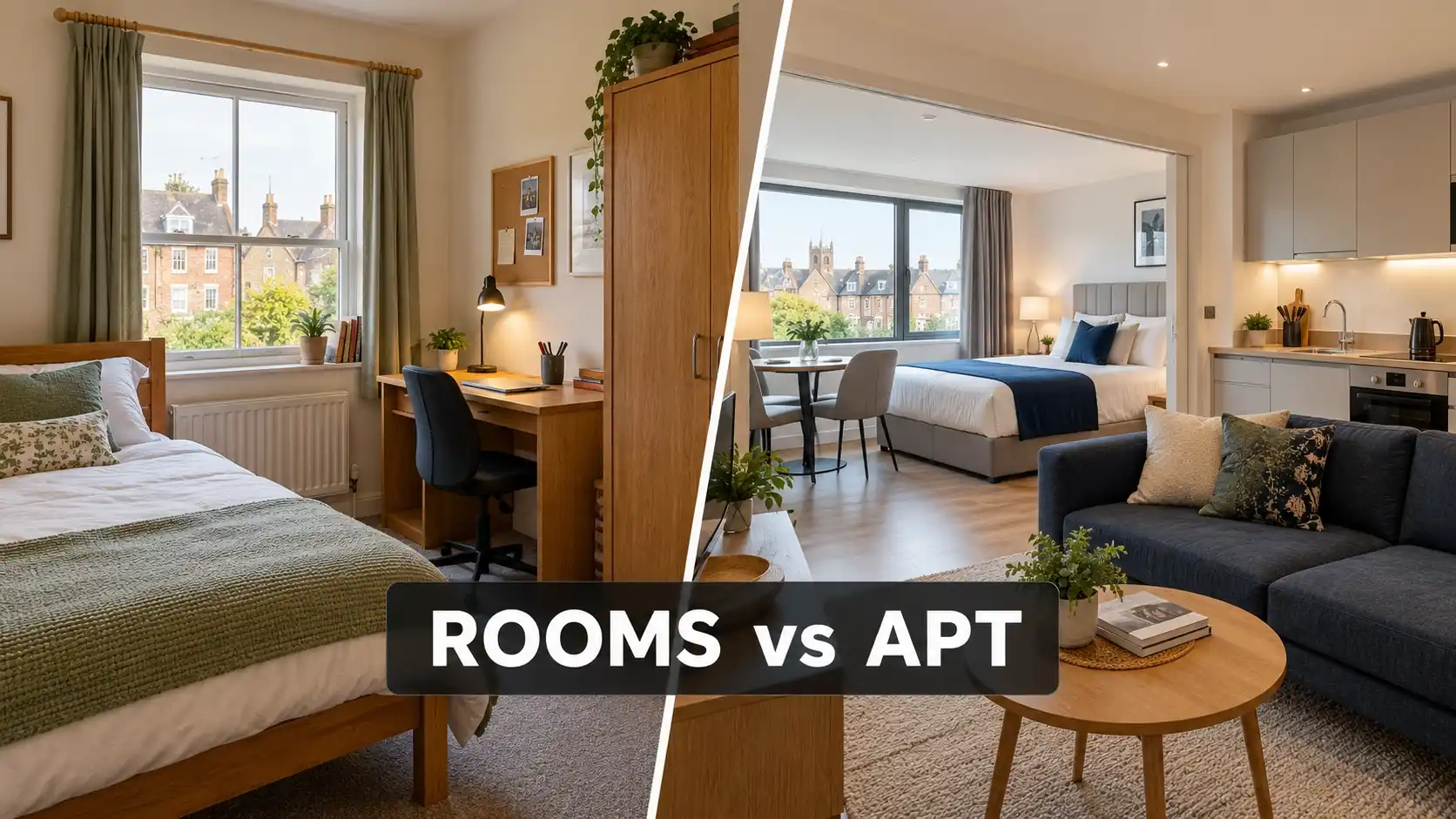

Six months is the awkward length. It is too long for a hotel, too short to be worth furnishing a flat, and since 1 May 2026 it is no longer a length you can put in a tenancy agreement at all, because the Renters’ Rights Act abolished fixed-term assured shorthold tenancies.
That leaves two realistic routes for a six-month posting: a corporate letting, where your company signs the tenancy, or a serviced apartment booked on a licence to occupy. The cost gap between them is smaller than most people assume once furniture, council tax, utilities and exit costs go into the same column. What actually separates them is who carries the risk and how much admin lands on your desk.
This guide compares the two on contract, cost, VAT, flexibility and risk, with a worked six-month example.
What is a corporate letting?

It is a tenancy granted to a business rather than to a person, which is why it sits outside the assured tenancy rules. Your company is the tenant and your employee is the occupier, usually under a separate licence from the company.
The legal consequence is the whole point. An assured tenancy requires an individual tenant occupying the property as their only or main home. A company cannot do that, so a corporate letting is a common law tenancy instead. It keeps the flexibility that individual tenancies lost in 2026:
- A fixed term is still possible, with a break clause if you negotiate one.
- The tenant is the company, so the covenants, the rent liability and the dilapidations risk sit with the business.
- The occupier can usually be swapped for another employee, if the agreement says so.
- Deposit protection rules and the Tenant Fees Act do not apply, because both are tied to assured shorthold tenancies and licences of housing. That cuts both ways, and the risk section below explains why.
Terminology varies. “Corporate letting”, “company let” and “corporate tenancy” mean the same thing. “Corporate housing” usually means a furnished, serviced product on a longer stay, closer to a serviced apartment than to a tenancy.
How is a Serviced Apartment Different?
A serviced apartment is normally a licence to occupy, not a tenancy at all. The operator keeps control of the property and supplies services, so your employee has permission to stay rather than exclusive possession.
In practice that means one nightly or weekly rate covering rent, gas, electricity, water, broadband, furniture, kitchen equipment, linen, housekeeping and usually parking, with a notice period instead of an eviction process at the end. Our plain guide to what a serviced apartment is sets out the licence model and how it differs from a tenancy in more detail.
Here is the practical comparison.
| Corporate letting | Serviced apartment | |
|---|---|---|
| Legal form | Common law tenancy to the company | Licence to occupy |
| Who signs | Your company | Your company or the traveller |
| Fixed six-month term | Yes, still possible | Yes, by booking |
| Typical minimum | 6 to 12 months | 2 to 7 nights |
| Furniture | Often unfurnished or part-furnished | Included |
| Utilities and broadband | You set up and pay | Included |
| Council tax | Usually the company’s liability | Operator’s problem |
| Cleaning and linen | Your responsibility | Included, typically weekly |
| Deposit | 5 to 6 weeks’ rent, not required to be protected | Usually none, or a small damage deposit |
| Exit | Contractual break or expiry, plus dilapidations | Notice period, typically 7 to 30 days |
| Swapping the occupier | Usually allowed if drafted in | Allowed, but see the VAT note below |
| VAT | Rent is exempt | Standard rated, then reduced from night 29 |
| Admin per booking | High: legal review, inventory, utilities, exit | Low: one contract, one invoice |
| Best for | 12 months plus, families, firm dates | 1 to 9 months, moving dates, single occupiers |
Why did the Renters’ Rights Act change this decision in 2026?

Because you can no longer sign a six-month fixed-term tenancy with an individual. The Renters’ Rights Act 2025 received Royal Assent on 27 October 2025 and its main provisions took effect on 1 May 2026. Assured shorthold tenancies and fixed-term assured tenancies were abolished, and existing ones converted to rolling periodic assured tenancies.
| What changed on 1 May 2026 | Effect on a 6-month posting |
|---|---|
| Fixed-term assured tenancies abolished | No six-month term to point at; the tenancy simply rolls. |
| Section 21 no-fault possession abolished | Landlords rely on modified Section 8 grounds and the courts. |
| Tenants may end a periodic tenancy on not less than two months’ notice, expiring at the end of a rent period | Your employee can leave, but you cannot hold the property to a fixed end date. |
| Rent in advance restricted | The old relocation workaround of pre-paying six or twelve months for an employee with no UK credit history has effectively gone. |
| Rent rises limited to once a year with two months’ notice, and contractual escalators void | Less certainty for landlords, which is pushing some towards corporate tenants. |
| Landlords must give a written statement of terms | More paperwork on the individual route. |
Corporate lettings were deliberately left outside all of this. Lettings to companies are not assured tenancies, so the reforms do not touch them, and the same is true of tenancies with annual rent above £100,000 and of genuine service occupancies. Serviced apartments are unaffected too, because a licence is not a tenancy.
The upshot is that the two options in this article are now the two that can still deliver a defined six-month arrangement. That is a change in the market, not a change in your preferences.
What does a six-month corporate letting actually cost?

Budget the rent plus roughly £2,500 to £3,000 of running costs for six months, and £2,500 to £5,000 more if the property is unfurnished. Rent is the number everyone quotes and the smallest part of the gap between the two options.
For scale, ONS put the average UK private rent at £1,400 a month in August 2026, with England at £1,459 and a one-bedroom home averaging £1,136. London averaged £2,332 and the North East £788.
A worked example for a two-bedroom regional property at £1,200 a month, over six months:
| Line | Cost |
|---|---|
| Rent, 6 months | £7,200 |
| Council tax, 6 months (Band C, illustrative) | £1,045 |
| Gas, electricity and water at about £180 a month | £1,080 |
| Broadband, including installation | £210 |
| TV licence, pro rata (£180 a year from April 2026) | £90 |
| Inventory, check-out and professional clean | £400 |
| Agency and company-let admin fees | £300 to £600 |
| Subtotal, furnished property | £10,325 to £10,625 |
| Furnishing an unfurnished property | £2,500 to £5,000 |
| Subtotal, unfurnished property | £12,825 to £15,625. |
| Deposit, 5 to 6 weeks’ rent (returnable) | £1,385 to £1,660 tied up. |
Costs are illustrative and vary by city, council tax band and property. Two lines deserve attention because they are the ones that get missed:
- Council tax. On a corporate letting the company is normally liable, including for any void period at either end of the term. A Band D bill in England in 2026/27 commonly sits in the £2,100 to £2,400 range.
- Dilapidations. Six months of one employee living in a property rarely ends in a dispute, but the company is the tenant, so the company argues it.
What does a six-month serviced apartment cost?
Expect £85 to £130 a night for a one-bedroom apartment before discount, falling by 20 to 30% on a stay of this length, with everything included. On a six-month booking the effective rate is what matters, not the rack rate.
| Nights booked | Typical discount |
|---|---|
| 7+ | 5 to 10% |
| 14 to 20 | 10 to 15% |
| 30+ | 15 to 25% |
| 90+ | 20 to 30% |
Worked through for 182 nights, which is six months:
| Scenario | Effective nightly rate | Six-month total |
|---|---|---|
| One-bed at £85, 25% long-stay discount | £63.75 | £11,603 |
| One-bed at £95, 25% long-stay discount | £71.25 | £12,968 |
| One-bed at £110, 25% long-stay discount | £82.50 | £15,015 |
| Two-bed at £140, 25% long-stay discount | £105.00 | £19,110 |
That figure is all-in: furniture, bills, broadband, housekeeping, linen and usually parking. There is no deposit cycle, no utility account to open and close, no inventory and no furniture to buy, store or dispose of.
There is also a VAT mechanic worth understanding. Accommodation of this kind is standard rated at 20%, but where the same person stays continuously for more than 28 nights, a reduced value rule applies from night 29 and the effective VAT on the accommodation element drops to roughly 4%. Our explainer on the reduced value rule for stays over 28 days covers how to structure the booking so it qualifies, and why a run of weekly reservations does not.
For a VAT-registered business recovering input tax on employee travel, the headline VAT is usually not a net cost anyway. Confirm the treatment with your accountant, because it depends on how the stay is contracted and who it is for.
Which is cheaper over six months?
A furnished corporate letting and a mid-market serviced apartment land within about £1,000 to £2,500 of each other, and the unfurnished corporate letting only wins if you already own furniture or the assignment is likely to extend.
| Option | Six-month cash cost | Cost per night | Setup and exit work |
|---|---|---|---|
| Corporate letting, furnished | £10,325 to £10,625 | £57 to £58 | Moderate |
| Serviced apartment at £85 list | £11,603 | £64 | None |
| Serviced apartment at £95 list | £12,968 | £71 | None |
| Corporate letting, unfurnished | £12,825 to £15,625 | £70 to £86 | High |
Six-month cash cost, illustrative

Corporate let, furnished    █████████████░░░░░░░   £10,325 – £10,625
Serviced apt at £85         ███████████████░░░░░   £11,603
Serviced apt at £95         ████████████████░░░░   £12,968
Corporate let, unfurnished  ████████████████████   £12,825 – £15,625
The honest reading is that cost is not the deciding factor at six months. It becomes one at twelve to eighteen months, where the corporate letting pulls clearly ahead because the furnishing cost amortises and the rent keeps compounding in your favour. Below about nine months, the serviced apartment usually wins on total cost of ownership once you price your own time.
Which option carries more risk for the employer?
The corporate letting, by a wide margin, because your company becomes a tenant with repairing, payment and dilapidations obligations for a fixed term.
The specific exposures worth naming:
- Your deposit is not protected. Tenancy deposit protection applies to assured shorthold tenancies. On a company let the landlord has no statutory duty to place your deposit in a scheme, and you have no scheme adjudication to fall back on. Ask where the money will be held and get it in writing.
- The Tenant Fees Act does not protect you either. Its ban on fees covers assured shorthold tenancies, student tenancies and licences of housing, so a landlord or agent may lawfully charge referencing and administration fees on a corporate letting, and take a larger deposit than the five or six weeks capped elsewhere.
- You are committed for the term. If the assignment is cut short, you hold the lease unless you negotiated a break clause. That is the single most expensive clause in the document.
- Possession is not simple just because it is not an assured tenancy. The arrangement ends under the contract, but an individual living in the property still has protections, and self-help eviction is a bad idea. Take advice before assuming you can recover the flat quickly.
- Duty of care still applies. Under the Health and Safety at Work Act 1974 an employer must take reasonable steps to protect employees, including where they sleep. On a corporate letting you are choosing the property, so gas safety, electrical condition and alarms are your diligence, not someone else’s.
- Sharing changes the rules. Put three or more unrelated employees in one house and you may be in HMO licensing territory.
On a serviced apartment, the operator holds most of that: the building compliance, the safety certificates, the insurance, the furniture, the council tax and the repairs. What you hold is a notice period.
None of this is legal advice. A corporate letting is a commercial lease of a home, and it deserves a solicitor’s eye before signature.
Can you swap the employee halfway through?
On a corporate letting, usually yes, and that is one of its genuine advantages. Because the company is the tenant, a well-drafted agreement lets you change the occupying employee without a new tenancy. For a rotating role or a project seat, that is worth real money.
On a serviced apartment you can also change occupier, but watch one detail: the 28-day VAT reduction is tied to the same person staying continuously. Swap the occupant and that clock can restart, which nudges the effective cost up. If you know a seat will rotate, say so at the quoting stage so the operator can price it properly rather than surprising you on invoice.
How does the tax and expenses treatment differ?
Residential rent is exempt from VAT, serviced accommodation is standard rated and then reduced from night 29, and both are usually a deductible business cost for a genuine temporary workplace.
Three things to get right:
- Temporary workplace rules. Accommodation and travel for an employee at a temporary workplace are generally allowable, but the relief fails once the posting is expected to last more than 24 months at that site. A six-month assignment is comfortably inside that, until someone extends it twice without checking.
- Subsistence is separate from accommodation. HMRC’s benchmark scale rates cover meals, not the bed. A property with a kitchen removes a chunk of the meal spend those rates only partly cover, which is one reason self-catering works out cheaper than it looks. Our guide to what HMRC’s subsistence rates do and do not cover sets out the 2026/27 figures and the mistakes that cost employers money.
- Provided living accommodation. Where an employer takes a property and houses an employee in it, consider whether a benefit in kind arises. The answer usually turns on whether the workplace is genuinely temporary and the accommodation is necessary for the work. Get it confirmed rather than assumed.
For how the accommodation line should arrive at your finance team in the first place, from purchase orders to payment terms, see our guide to invoicing, VAT and payment terms for contractor accommodation.
Which should you choose for a six-month assignment?
Serviced apartment if the dates might move, the occupier might change, or nobody on your team wants to become a landlord’s tenant. Corporate letting if the dates are firm, the term is likely to extend past a year, or the employee is bringing a family and wants a home rather than a product.
| Choose a serviced apartment when | Choose a corporate letting when |
|---|---|
| The end date is programme-dependent | The assignment is firmly 12 months or longer |
| One person, or a rotating seat | A family is relocating with the employee |
| You want a single invoice with bills inside it | You have a portfolio of assignments in one city |
| The employee arrives before their UK bank account works | The employee wants their own furniture and a school catchment |
| You do not want a legal review or an inventory | Cost per month is the board’s only metric |
| Speed matters: days, not weeks | You can absorb the setup and exit admin |
A middle path works surprisingly often: book a serviced apartment for the first six to eight weeks, then decide. By then the employee knows the city, the assignment length is clearer, and if a corporate letting still makes sense you sign it with information instead of guesses.
How should you brief a provider or an agent?
Send the same facts to both sides and the comparison becomes like-for-like:
- Dates, and whether the end date is firm or programme-dependent
- Occupancy, how many people and whether the occupier may change
- Location by postcode, not by town
- Parking, number of vehicles
- What is included, itemised: bills, broadband, cleaning frequency, linen, council tax
- Furniture standard, if you are comparing an unfurnished tenancy
- Break rights and notice period, in writing
- Invoicing, company name, PO reference and payment terms
- Whether the 28-day VAT reduction will be applied, and from which night
Guests House runs serviced apartments and whole houses across Somerset and Milton Keynes with parking, full kitchens, laundry, fast Wi-Fi and self check-in. We invoice companies directly with a PO reference, apply the reduced value rule on qualifying long stays, and step the rate down as the booking lengthens through our business and extended stay rates.
Corporate lettings and serviced apartments: FAQs
What is a corporate letting?
A tenancy granted to a company rather than an individual, with an employee occupying the property. Because the tenant is a business, it is not an assured tenancy and sits outside the Housing Act 1988 regime.
Is a company let the same as a corporate letting?
Yes. “Company let”, “corporate letting” and “corporate tenancy” are used interchangeably.
Can you still get a six-month tenancy in 2026?
Not as an assured shorthold tenancy with an individual. Fixed terms were abolished on 1 May 2026 and tenancies are now periodic. A fixed six-month term is still possible on a corporate letting, or by booking a serviced apartment.
Does the Renters’ Rights Act apply to company lets?
No. Lettings to companies are not assured tenancies, so the Act’s reforms do not apply to them. Tenancies with annual rent above £100,000 and genuine service occupancies are also outside the regime.
Is a serviced apartment a tenancy?
Normally no. It is a licence to occupy, so there is no assured tenancy, no deposit protection scheme and no eviction process, just a contractual notice period.
Which is cheaper for six months?
They are close. A furnished corporate letting at £1,200 a month works out around £10,300 to £10,600 all-in for six months, against roughly £11,600 to £13,000 for a mid-market serviced apartment. An unfurnished property costs more once you buy furniture.
Is my deposit protected on a corporate letting?
Not automatically. Deposit protection applies to assured shorthold tenancies, so on a company let there is no statutory requirement to use a scheme. Agree in writing where the money is held.
Can a landlord charge fees on a corporate letting?
Yes. The Tenant Fees Act 2019 covers assured shorthold tenancies, student tenancies and licences of housing, so referencing and administration fees can lawfully be charged on a company let.
Who pays council tax on a corporate letting?
Usually the company as tenant, including during void periods at either end of the term. On a serviced apartment it is the operator’s liability.
Can we change which employee uses the property?
On a corporate letting, usually yes if the agreement allows it. On a serviced apartment yes, but changing occupier can restart the 28-day clock for the reduced VAT rate.
Do we get VAT relief on a long serviced apartment stay?
Where the same person stays more than 28 continuous nights on one booking, a reduced value rule applies from night 29, taking effective VAT on the accommodation element to roughly 4%.
What happens if the assignment is cut short?
On a serviced apartment you serve the contractual notice, typically 7 to 30 days. On a corporate letting you are committed for the term unless you negotiated a break clause, which is why that clause matters more than the rent.