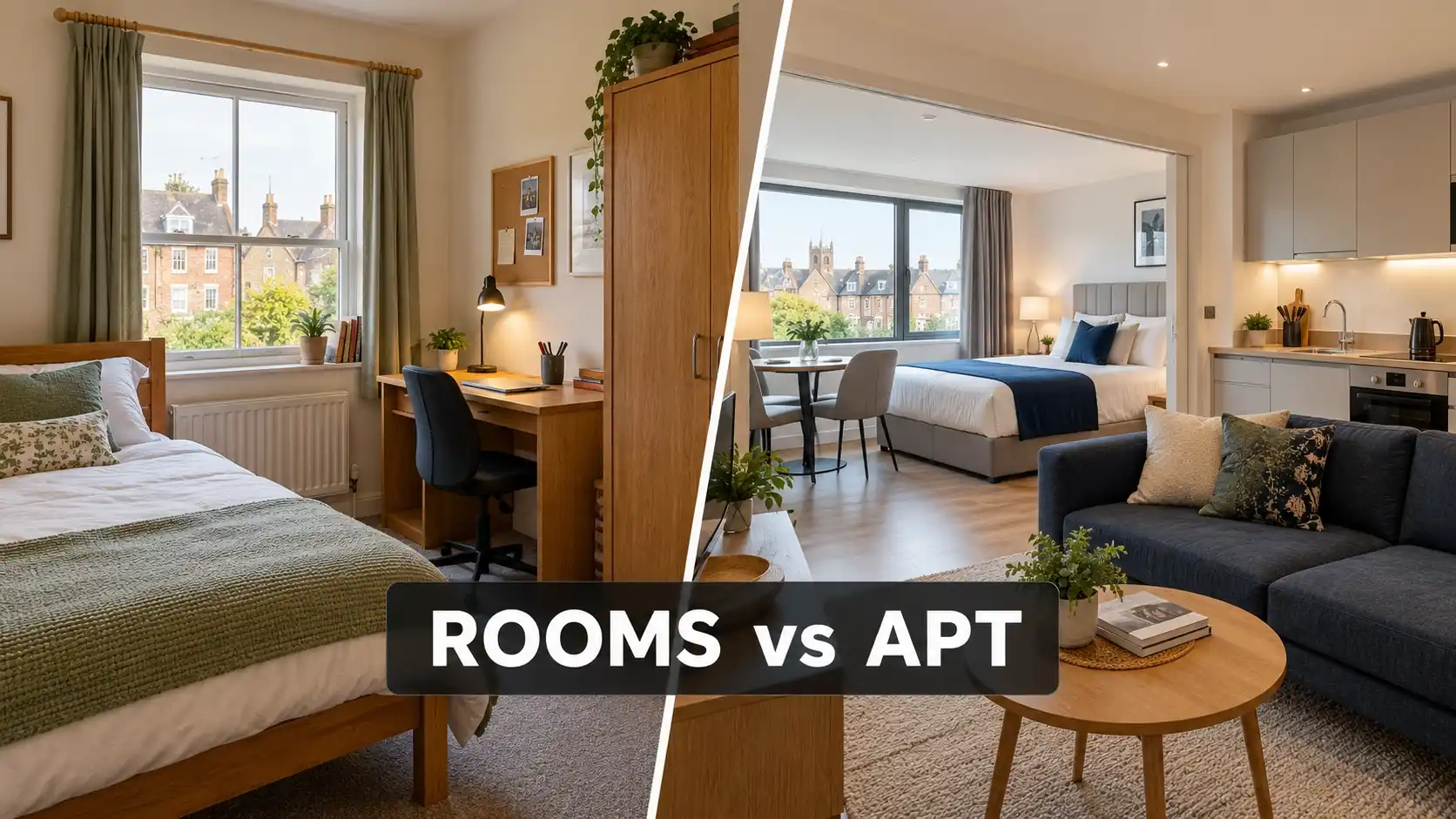
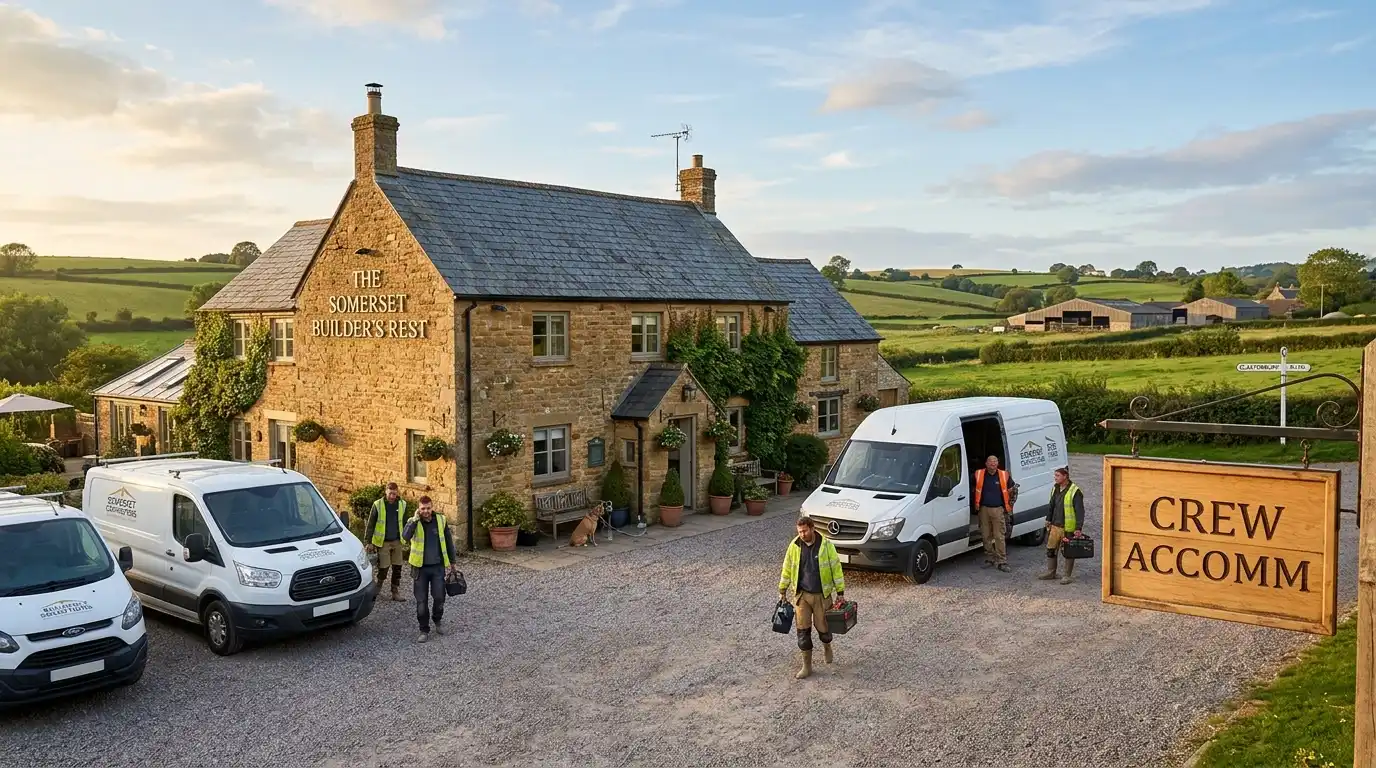
A crew booking puts a whole building team under one contract, one invoice and one arrival date, instead of several separate room reservations.
A single tradesperson picks a room. A crew of six picks a system: who arrives first, where six vans park, whose name sits on the invoice, and whether one kitchen can feed six people at 9pm without a queue for the hob. Somerset’s construction pipeline has turned that system into a weekly question for site managers booking teams for Hinkley Point C, the Gravity Smart Campus and the smaller contracts running through Bridgwater, Highbridge, Taunton and Yeovil.
What counts as a group or crew booking?
A group or crew booking is a reservation for two or more workers staying under one contract, arranged as a single transaction rather than as separate individual bookings. Operators typically split it into three bands, because the band decides parking allocation, invoicing and which properties are even physically able to take the group.
| Crew size | Band | Typical setup |
|---|---|---|
| 2–4 workers | Small crew | One apartment |
| 5–8 workers | Mid-size crew | One house, or two linked apartments |
| 9+ workers | Large crew | Multiple properties under one master booking |
A booking only counts as a “crew” booking once it is confirmed as one contract. Six individuals booking six separate rooms on six separate confirmations are six single bookings that happen to share a job, not a crew booking, and they lose every advantage a crew booking is built to give: one invoice, guaranteed parking, and one point of contact when something needs fixing.
Why is crew accommodation demand rising in Somerset?

Demand is rising because the construction industry needs tens of thousands of extra workers a year nationally, and Somerset is currently running two of the region’s largest live construction projects at once. The Construction Industry Training Board’s Construction Workforce Outlook 2026–2030 states that UK construction employed 2,606,380 people in 2025 and needs to reach 2,681,800 by 2030, which requires an average of 41,200 additional workers joining the sector every year, more than 206,000 in total over the five-year period.
That national shortage lands hardest in areas with concentrated, large-scale projects, and Somerset currently has two of them within a few miles of each other.
| Project | Location | Scale | What it means for crew accommodation |
|---|---|---|---|
| Hinkley Point C | Bridgwater / Stogursey | EDF’s own estimate puts peak workforce at around 8,600 people, with roughly 40% expected to live in their existing homes | The majority of demand for temporary lodgings sits in the Sedgemoor area, close to the main site and bus routes |
| Gravity Smart Campus (Agratas gigafactory) | Puriton, near Bridgwater, Junction 23 of the M5 | A £4 billion investment creating up to 4,000 direct jobs at the gigafactory, plus thousands more in the supply chain | Construction of the facility itself is ongoing through 2026, running alongside Hinkley Point C rather than after it |
| Bridgwater town-centre regeneration (Celebration Mile and similar works) | Bridgwater | Multi-phase contracts running months at a time | Shorter, recurring crew bookings rather than one long placement |
Two projects of that size overlapping in one county means crews are not booking a single week here and there. They are booking blocks of eight, twelve or twenty weeks, often with the crew rotating partway through, which is exactly the pattern a group booking is designed to absorb and a string of individual hotel bookings is not.
Whole house, multiple apartments, or a hotel block – which suits a crew?
The right format depends on crew size, not personal preference, because kitchen capacity and parking scale differently across the three options.
| Format | Best crew size | Kitchen | Parking | Invoicing |
|---|---|---|---|---|
| Whole house | 4–10 | One shared kitchen, sized for the group | Usually two to four spaces on site | One invoice |
| Two linked apartments | 5–8 | Two kitchens, which splits the cooking load | Allocated per apartment | One invoice can still cover both, if booked as a single contract |
| Hotel block (multiple rooms) | Any size | None, or a shared breakfast room with fixed hours | Rarely guaranteed, and rarely enough for a whole crew’s vans | One invoice per room, unless a corporate rate is separately negotiated |
In practice, a crew of six splits better across two three-bed houses than into one packed property, because two kitchens beat two hobs at eight in the evening. A single house works well for a crew that finishes on the same shift at the same time; two smaller properties work better once the crew includes a mix of trades, seniority, or shift patterns.
How many bedrooms does a crew actually need?
A crew of four needs a minimum of three bedrooms to avoid three people sharing, and a crew of ten needs either one five-bedroom house or two smaller properties booked together.
| Crew size | Recommended bedrooms | Typical configuration | Bathrooms needed |
|---|---|---|---|
| 2–3 workers | 1–2 bed apartment | One apartment | 1 |
| 4–6 workers | 3-bed house | One house, twin or double rooms | 1–2 |
| 7–10 workers | 5-bed house, or two properties | Split by shift pattern if the crew is mixed | 2–3 |
| 10+ workers | Multiple houses or apartments | Block-booked under one contract, across one town | Varies by property |
The largest whole-house properties across the Somerset portfolio, Bridgwater, Highbridge, Taunton and Yeovil, sleep up to ten people across five bedrooms, which covers most single-crew bookings without splitting the group across two addresses.
What does a crew booking need beyond bedrooms?
Bedrooms are the easy part. Four features decide whether a crew booking actually works day to day.
Parking allocated per vehicle, not per room. A crew of five arrives with five vans, and “parking nearby” solves nothing when tools are locked inside them overnight. UK tradespeople lost an estimated £99 million to tool theft in 2025, so a crew booking needs a written confirmation of one space per vehicle, not an assumption based on room count. Our full breakdown of parking, kitchen and laundry needs for site workers covers the individual-level numbers behind this if you need them for a client proposal.
A kitchen sized for the whole group, not one person. Six people cannot cook on two hobs at the same time, so a crew property needs an oven, a full-size fridge-freezer and enough pans and plates for the headcount sleeping there, not a kitchenette built for a couple on a weekend break.
Laundry capacity that scales with headcount. One small washing machine handles two workers’ kit comfortably. Six workers need either two machines, an agreed rota, or a split across two properties, because workwear left waiting for a slot does not dry in time for the next shift.
A split by shift pattern where the crew is mixed. Day and night shifts sharing one house is the single most common complaint in group accommodation, because a day-shift arrival at 6pm and a night-shift departure at 7pm collide in the same kitchen and the same hallway. Splitting a mixed crew across two properties by shift pattern, rather than mixing days and nights under one roof, removes that friction before it starts.
How does check-in work when a crew arrives at different times?
Check-in for a crew booking runs on self check-in, not a reception desk, because six people rarely land at the same hour. A keysafe or smart lock code sent to the crew leader ahead of arrival lets the first person in at 3pm and the last person in at 9pm without anyone waiting outside. One property contact number covers the whole crew, so a delayed shift or a lost code is one phone call, not six.
How is a group booking invoiced and paid?
A group booking is invoiced to the company as a single document covering every bed, with a PO reference added on request and payment terms agreed before the crew arrives rather than a card taken at check-in. Two details matter more for a group than for a single room:
- Length-of-stay discounts apply to the whole booking. Stays of 10 or more nights carry 10% off, 20 or more nights carry 15% off, and 30 or more nights carry 20% off, and most crew bookings on a Somerset project run well past the 30-night threshold on their own.
- Headcount changes need agreeing upfront. A crew rarely stays the same size for eight or twelve weeks. Confirm in writing how adding or removing a bed mid-booking is handled, and what the cancellation terms are for the group as a whole, before the crew travels rather than partway through the contract.
What does a crew booking cost against a hotel block?
Splitting a crew of six across six separate hotel rooms costs roughly three times more per week than housing the same crew in managed accommodation, once parking, food and laundry are added to the room rate.
| Cost line (crew of six, one week) | Hotel block (6 rooms) | Managed accommodation (two 3-bed houses) |
|---|---|---|
| Beds | £2,940 | £1,260 |
| Parking (6 vehicles) | Rarely guaranteed; add roughly £500 where available | Included, allocated per vehicle |
| Food | Roughly £834 (takeaway and meal-deal mix) | Roughly £270 (one grocery shop across two kitchens) |
| Laundry | Roughly £132 (two launderette runs) | Roughly £12 (machines in each property) |
| Invoicing | Up to six separate folios | One invoice, one PO reference |
| Weekly total | ~£4,400–£4,900 | ~£1,540 |
These are indicative figures that move with region and season, not a quote. Our per-person cost breakdown of hotels against managed accommodation puts the weekly gap at roughly £478 per person, which scales to more than £34,000 across a twelve-week package for a crew of six, the same crew size in this table, calculated a different way.
The group booking checklist
Ten details, confirmed in writing before the crew travels.
- Total headcount, and whether it is likely to change mid-project
- Shift pattern, one pattern across the crew, or a mix of days and nights
- Number of vehicles that need a parking space
- Arrival dates, and whether the whole crew lands on the same day
- One property or a split across two, and the logic behind the split
- Minimum bedrooms and bathrooms for the confirmed headcount
- Company name, PO reference and payment terms for the invoice
- Cancellation and amendment terms if the headcount shifts
- A single named contact for the crew, and a single contact at the property side
- Written confirmation of all of the above before anyone travels
Where in Somerset works best for a crew booking?
Bridgwater sits closest to both Hinkley Point C and the Gravity Smart Campus, and Hinkley Point C’s own Centres of Excellence and Jobs Service are based in Bridgwater and Cannington, which makes it the natural base for crews on either project. Highbridge sits a short run from Bridgwater and Burnham-on-Sea, and suits crews who want a quieter residential base with the same commute distance. Taunton, the county town, works for crews on town-centre or business-hub contracts further from the M5 corridor. Yeovil covers crews working contracts in south Somerset, away from the Bridgwater cluster entirely.
Explore properties in Bridgwater, Highbridge, Taunton and Yeovil to compare what each town has available for a group.
How we handle group and crew bookings at Guests House
Guests House runs whole houses and apartments across Bridgwater, Highbridge, Taunton and Yeovil, built to take a crew as one booking rather than a scatter of individual rooms, self check-in for staggered arrivals, parking confirmed per vehicle, and one company invoice covering the whole group on our business and extended stay rates.
If you’re weighing a house against a hotel for the first time, our plain comparison of serviced apartments against hotels and our guide to what a serviced apartment actually includes cover the basics. For crews specifically heading to Hinkley Point C, our dedicated guide to accommodation near Hinkley Point C covers how early to book before the useful stock goes.
Send us a postcode, headcount, shift pattern and dates, and we’ll tell you straight what fits, one property or two, and what it costs as one invoice.
FAQs
What is a group or crew booking?
A reservation for two or more workers staying under one contract, one invoice and one arrival date range, rather than as separate individual room bookings. Most operators band crews as small (2–4), mid-size (5–8) or large (9+), since the band changes which properties and how much parking the booking needs.
How many bedrooms does a crew of six need?
A three-bedroom house comfortably covers a crew of six in twin or double rooms. Above eight people, either a five-bedroom house or two smaller properties booked together works better than packing everyone into one address.
Can a crew booking be invoiced to the company instead of individuals?
Yes. A group booking is normally invoiced as a single document covering every bed, with a PO reference added on request and payment terms agreed before arrival rather than a card taken at check-in.
What happens if a crew’s headcount changes mid-project?
This should be agreed in writing before the crew travels. Confirm how adding or removing a bed partway through the booking is handled, and what the cancellation terms are for the group as a whole, rather than assuming the original terms stretch automatically.
Is parking guaranteed for every vehicle in a crew booking?
Only if it is confirmed in writing before arrival. A crew of five needs five spaces agreed in advance, not an assumption that “parking nearby” will cover five vans with tools locked inside overnight.
How much does a crew booking save against a hotel block?
For a crew of six, six hotel rooms with parking, food and laundry added typically run to roughly £4,400–£4,900 a week, against roughly £1,540 a week for the same crew across two managed three-bed houses, a gap of more than £34,000 across a twelve-week package.
Should a mixed day and night crew share one property?
It works better split across two properties by shift pattern. Day and night shifts sharing one kitchen and one hallway at shift-change time is the most common complaint in shared crew accommodation.
Which Somerset town is best for a crew working on Hinkley Point C or Gravity?
Bridgwater, since both projects sit closest to it and Hinkley Point C’s own Centres of Excellence and Jobs Service are based there. Highbridge is the next-closest alternative for crews wanting a quieter base on the same commute.